
 See all news
 How to reach us
70 Bolduc Street, Gaspé, Quebec
Canada G4X 1G2
On the sidelines of the 27the Conference of the Parties (COP27), Nergica held the second edition of its Transition Solutions Symposium on November 15, 2022, at the Delta Hotel in Ottawa.
Building on the success of the first edition during which the need to accelerate the energy transition had been demonstrated, Nergica invited key figures from the fields of research, industry, and the energy transition to work together to develop concrete and transformative solutions that could facilitate the rapid deployment of renewable energy.
Nine experts from diverse backgrounds shared their perspectives on the barriers to Canada’s energy transition. Led by Peter Tertzakian, moderator and deputy director of the ARC Energy Research Institute, the panelists and participants then discussed which solutions to prioritize in the areas of financing, the workforce, and the development of the infrastructure needed for the energy transition.
Key Takeaways
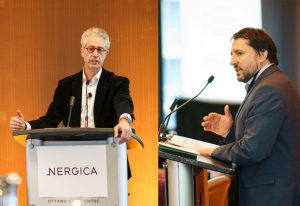
Experts :
Peter Tertzakian, moderator and deputy director of the ARC Energy Research Institute
Frédéric Côté, CEO at Nergica
The urgency of taking action together was at the heart of the opening remarks delivered by Peter Tertzakian and Frédéric Côté.
“When we think about the challenges ahead and our goal of achieving carbon neutrality by 2050, we only have 20 years left. There’s a sense of urgency.” — Peter Tertzakian.
“Time is running out. Now more than ever, it is important to come together and collaborate to accelerate the energy transition and achieve carbon neutrality. Nergica invites stakeholders to adopt a solution-oriented mindset and take action now.” — Frédéric Côté.
Although both agree that the programs put in place to support the energy transition are not to be criticized, the ambitious targets set by Canada and each of its provinces are far from being met:
But this leaves several questions unanswered:
What are the key factors for a successful energy transition? What is needed to accelerate the shift from fossil fuels to renewable energy in Canada? What solutions can we implement right now to promote swift action across the country? These were the questions that panelists and participants at the Transition Solutions Symposium were invited to address.

Experts :
Peter Tertzakian, Deputy Director of the ARC Energy Research Institute
Mark Chapeskie, Vice President of Program Development at Human Resources, Electric Industry of Canada
Sara M. Alvarado, Executive Director of the Institute for Sustainable Finance
Mark Chapeskie kicked off the first discussion on energy transition planning.
According to him, the workforce in the renewable energy industry is currently under pressure. Major demographic shifts have occurred as a result of the pandemic, and nearly 300,000 Canadians have retired in the past year and will need to be replaced. In addition to the many positions that are already vacant, new ones will soon be created as part of the energy transition. As a result, it will become increasingly difficult to find skilled workers to fill the positions needed to roll out renewable energy. In fact, according to available studies, it takes five years to acquire the necessary skills starting from scratch—a highly problematic issue given that we have very little time!
“In the long term, we know that energy needs will rise sharply. As a result, we will need at least one and a half or two times as many workers specialized in renewable energy to meet the demand.” — Mark Chapeskie.
Sara M. Alvarado agreed that the shortage of skilled labor is the main bottleneck hindering the acceleration of the energy transition. Indeed, all too often, funding is available, but it is the lack of resources to properly evaluate and assess projects that slows down their implementation.
Currently, the financial industry, insurance companies, and banks are all actively seeking new talent with expertise in sustainability to meet growing demand. According to Sara, sustainability should not be an elective course in finance programs. Anyone studying finance should have knowledge of sustainability.
"At every level, decision-makers need support and advisors with expertise in sustainable development to help them make the right decisions." — Sara M. Alvarado.
Following this initial discussion, participants were invited to consider the following question: How can Canada ensure that the availability of labor and expertise does not hinder a rapid transition?
Here are a few suggested solutions, in quick succession:
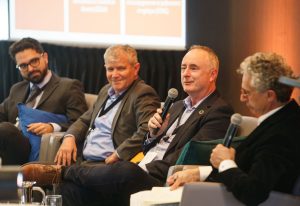
Experts :
Peter Tertzakian, Deputy Director of the ARC Energy Research Institute
Moe Kabbara, Director of Electrification at the Transition Accelerator
Yvan Cliche, fellow, Senior Energy Researcher at the Center for International Studies and Research at the University of Montreal (CÉRIUM)
Stuart Galloway, Executive Vice President / Western Canada at SOFIAC
“Canada has all the natural resources needed for the energy transition, such as solar, wind, and hydroelectric power. We also have the funds to make it happen. It’s frustrating that we can’t move faster. Collaboration is so important.” — Peter Tertzakian
An expert in the field of renewable energy and climate change, Moe Kabbara identified from the outset the lack of policy alignment across different levels of government as an obstacle to the energy transition. He specifically cited public utilities as an example, noting that they generally do not have a mandate to develop a carbon-neutral grid and instead aim to offer the lowest possible cost. How can we ensure that the federal goals for 2030 and 2050 are implemented by provincial authorities and then by public utilities?
Drawing on his expertise in energy geopolitics, Yvan Cliche emphasized the growing demand for energy and the far-reaching and profound changes that will result. Indeed, the growing demand for renewable energy will result, for example, in a proliferation of wind and solar farms, power lines, and mining sites. The Canadian landscape will be transformed, and we will most likely have to turn to China to secure our supply of critical minerals.
For his part, Stuart Galloway, a specialist in innovative financing structures, emphasized that while there is plenty of money available to invest in projects, there isn’t necessarily accessible financing that can be used to invest wisely in clean energy projects. Furthermore, the lack of a long-term perspective in today’s decision-making will have a negative impact on our ability to achieve carbon neutrality by 2050. For example, replacing a boiler or generator in 2022 will affect our future outcomes.
"One of the problems or obstacles to investment is analysis paralysis. We need to stop producing endless reports and simply take action." — Stuart Galloway
Following this second discussion, participants were invited to consider the following question: What is the main obstacle to establishing a transition infrastructure, and what are the solutions?
Here are a few suggested solutions, in quick succession:
"Collaboration is important, but it is essential to develop a more coherent form of collaboration." — Moe Kabbara.

Experts :
Peter Tertzakian, Deputy Director, ARC Energy Research Institute
Frédéric Côté, Executive Director, Nergica
Brandy Giannetta, Vice President, Public Policy, Government Affairs, and Regulatory Affairs, Canadian Renewable Energy Association
Eamonn McGuinty, Senior Policy Advisor to the Minister of Environment and Climate Change, Government of Canada
“We have a jigsaw puzzle ahead of us. We know we have all the pieces, but we don’t have the box with the picture to recreate. To succeed, we must first understand what we’re trying to put together with this puzzle. So we need a clearer vision of what life will look like in a carbon-neutral Canada and of what we’re trying to achieve.” — Frédéric Côté.
Following up on the first two discussions, Peter Tertzakian invited Frédéric Côté, Brandy Giannetta, and Eamonn McGuinty to revisit the challenges and solutions that had been raised in order to identify a few priority actions.
Eamonn McGuinty, who was representing the Honorable Steven Guilbeault, acknowledged that the implementation of funding and subsidy programs has been very slow, and that businesses and individuals have been slow to take advantage of them. According to him, the lack of certainty regarding the future of renewable energy is holding back businesses and organizations from making bold investments. Mr. McGuinty suggested looking at what is being done in the United Kingdom and Germany with the Carbon Contracts for Difference(CCFD), which help reduce uncertainty about future carbon prices. Indeed, this type of contract eliminates the risk that a change in government or political instability could disrupt the carbon price, thereby helping to stimulate investment in clean technologies.
According to Brandy Giannetta, we face a challenge of scope and scale when it comes to developing solutions to accelerate the energy transition. Speed of execution is crucial, as is the need to scale up proven initiatives—whether in innovation, regulation, or training. On this last point, she also noted that CanREA is actively collaborating with Human Resources, Electric Industry of Canada to shed light on various training pathways and certification requirements, and is ensuring that different sectors are connected with training providers to quickly prepare the workforce needed for the transition.
Finally, Frédéric Côté highlighted the important role of applied research and, more generally, of knowledge sharing. As a college-based technology transfer center (CCTT) affiliated with the Cégep de la Gaspésie et des Îles, Nergica contributes directly to training the next generation of professionals in renewable energy. He also highlighted the significant contribution of CEGEPs and colleges to training the workforce needed for the energy transition, citing the example of the Cégep de la Gaspésie et des Îles, which is currently adapting its electrical engineering program to meet the needs of the wind energy industry. In his view, this is a solution that could easily be scaled up.
Peter Tertzakian then took the floor to discuss the importance of collaboration within the sector, while highlighting the future challenges that still lie ahead. And on that note, the second edition of the Transition Solutions Symposium came to a close, leaving us with several key takeaways regarding the contribution of each stakeholder in Canada’s energy transition sector—but also, and above all, the urgent need to act quickly and collectively.
Stay up to date on the latest industry news by subscribing to our newsletter today.

Privacy policy ©2026 Nergica | Réalisation DACTYLO