
 See all news
 How to reach us
70 Bolduc Street, Gaspé, Quebec
Canada G4X 1G2
* An earlier version of this article was published in the Mining and Industry Resources Magazine.
Quebec’s wind energy sector has seen most of its growth over the past two decades. With nearly 4,000 MW of installed capacity, the wind power industry is a major sector that generates significant benefits both financially and in terms of the economic development of Quebec and its regions.
In recent years, stagnation in both the domestic and export markets has led to a production surplus at Hydro-Québec. The result? Wind power development has been put on hold.
All signs point to the coming years being promising once again for Quebec’s wind energy sector. Like other countries, Quebec has set an ambitious target for reducing its greenhouse gas (GHG) emissions: a 37.5% reduction by 2030 compared to 1990 levels.[1].
To achieve this goal, the province is focusing, in particular, on the electrification of transportation, buildings, and industries. This will require increasing electricity generation from clean energy sources such as wind, hydroelectric, and solar power.
In early February, as part of the launch of the Apuiat wind project, Premier François Legault and Hydro-Québec’s new CEO, Sophie Brochu, opened the door to potential calls for bids. The indicators therefore seem to point toward a resurgence in wind power development in Quebec.
Following four wind energy tenders, Quebec currently has 47 wind farms within its borders, with a total installed capacity of 3,882 MW[2].
At the height of their development, Quebec’s wind energy projects led to the creation of 5,000 full-time jobs, many of them in manufacturing companies in the Gaspésie–Îles-de-la-Madeleine region and the La Matanie RCM, and nearly 1,000 in Montreal[3].
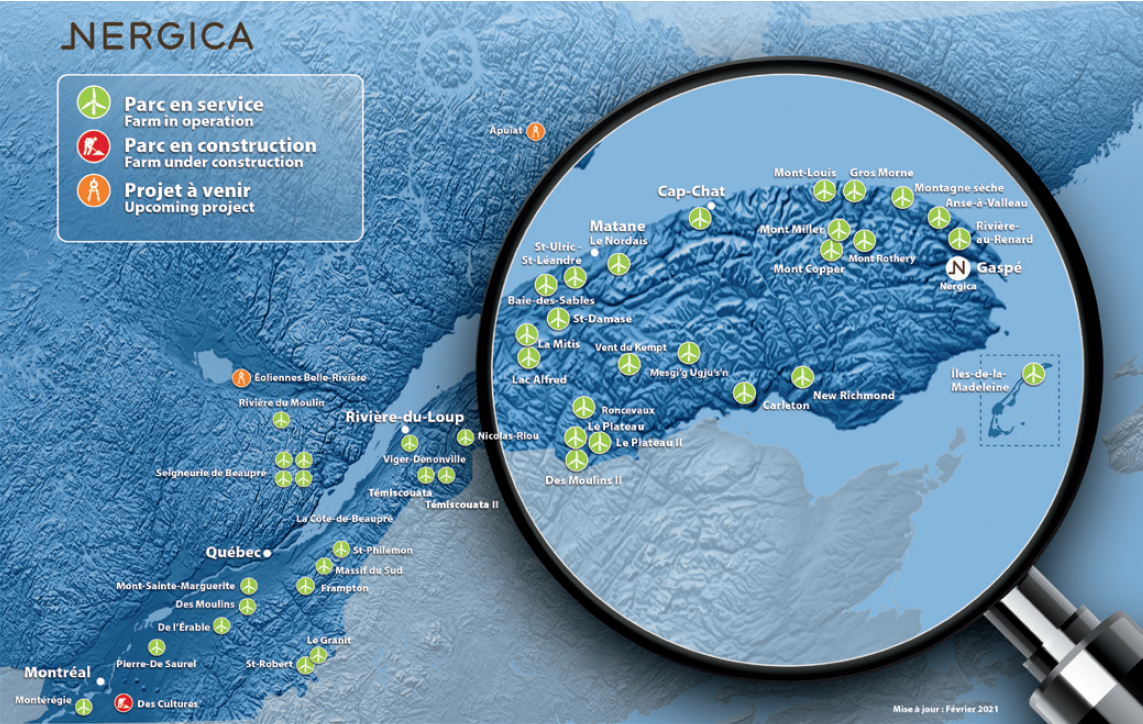
Map of Wind Farms in Quebec
The construction of wind farms in Quebec has generated $10 billion in investments over the past 20 years. This amount includes the necessary upgrades to Hydro-Québec’s transmission grid, investments in businesses, and the development of wind farms.[4] Construction work related to the installation of wind farms alone has resulted in investments of approximately $8 billion.
It is clear that wind energy projects are very well integrated into local communities, offering, in particular, numerous financial benefits.
Currently, nearly 70 municipalities, unoccupied territories, and Indigenous territories are home to an operational or planned wind farm[5].
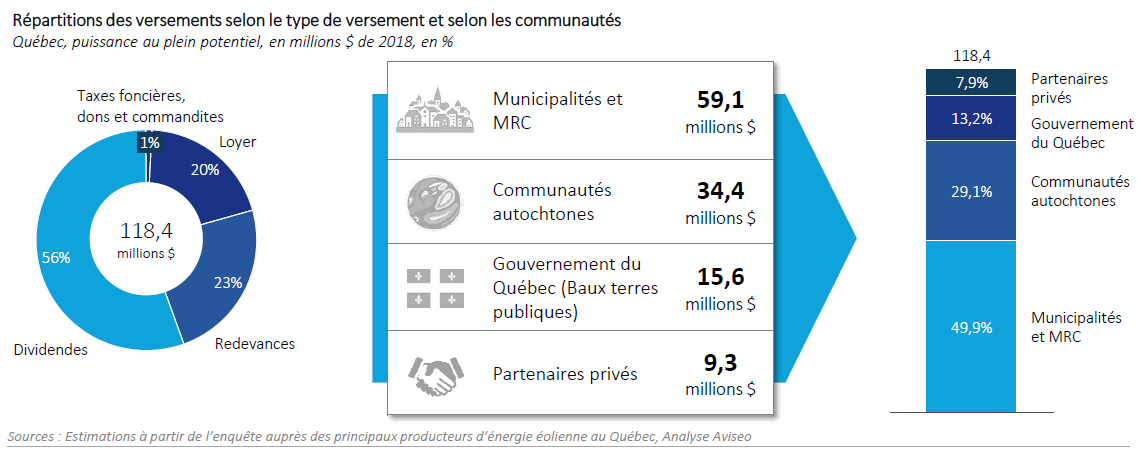
Payments to the various communities total nearly $120 million annually, according to a report produced by Aviseo Conseil[6]. In 56% of cases, they take the form of dividends.
Royalties totaled $27.8 million, accounting for 23% of payments to communities, while $23.6 million was paid in rent, primarily to the Ministry of Energy and Natural Resources (MERN) for the lease of public lands.
In 2018, with $59.1 million in payments of all kinds, municipalities received about half of all funds disbursed. Indigenous communities, for their part, were set to receive more than a quarter of all payments, for a total of $34.4 million.
In addition, payments to the Government of Quebec under leases for public lands were expected to reach $15.6 million, according to the Aviseo Conseil report.
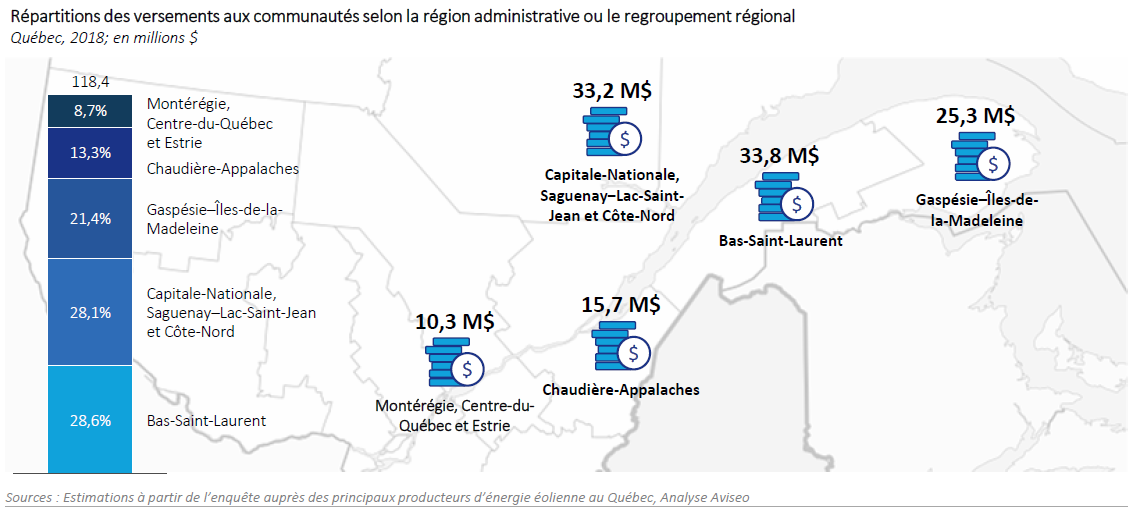
The Bas-Saint-Laurent and Gaspésie-Îles-de-la-Madeleine regions are faring particularly well because they have formed intermunicipal energy agencies that have joined together under the L’Alliance de l’Est consortium. Thanks to this initiative, the 154 municipalities in Eastern Quebec now each hold a 50% stake in the Roncevaux (near the Matapédia River) and Nicolas-Riou (near the town of Trois-Pistoles) wind farms.
Overall, the Bas-Saint-Laurent region receives the most funding for its communities, with a total of $33.8 million.
The annual revenue expected by the governments of Quebec and Canada is estimated at more than $32 million.
In 2020, as existing and planned wind farms reached their full potential, the Quebec government was expected to collect $24.2 million in revenue, including $8.9 million in personal income tax, $8.7 million in public services tax (PST), and $1.2 million in contributions to the Health Services Fund (HSF).[7].
The federal government will receive a total of $7.8 million, including $6.3 million in personal income tax. In addition to contributions to the Social Security Fund (FSS), direct and indirect tax-like charges will total $8.9 million for the federal and Quebec governments. However, these amounts are not included in the governments’ revenues.
Quebec’s wind energy industry, which comprises more than 150 Quebec-based companies, has developed a wide range of expertise over the years. In fact, it is the most developed supply chain in Canada.
Many of these companies export their products and services. As a result, Quebec’s expertise is recognized as a cutting-edge solution that can contribute to the electrification of other markets. For example, LM Wind Power, a wind turbine blade manufacturing plant based in Gaspé, employs nearly 500 people and currently exports 100% of its production.
For its part, Techéol, a company specializing in technical services and maintenance for wind farms, generates 30 to 40 percent of its revenue outside Quebec. Its 130 employees serve nine provinces and U.S. states and have repaired more than 2,000 wind turbines.

Baie-des-Sables Wind Farm
With no wind power development in Quebec in recent years, Quebec-based developers and operators have also turned their attention abroad. Pioneers such as Innergex Renewable Energy and Boralex have commissioned several energy projects outside Quebec, primarily in the wind, solar, and hydroelectric sectors.
Innergex has built and acquired facilities in Canada, the United States, France, and Chile with a total capacity of 2,742 MW, including 1,575 MW of wind power. The Canadian market accounts for 1,454 MW of net installed capacity, followed by the United States with 916 MW, France (221 MW), and Chile (151 MW). The independent power producer is also working on numerous potential projects at various stages of development. Although there is no guarantee that these projects will come to fruition, they nevertheless represent a combined net installed capacity of 6,871 MW. At the same time, Innergex and Hydro-Québec have formed a strategic alliance in the renewable energy sector that will enable them to jointly invest in large-scale projects.
For its part, Boralex develops, builds, and operates renewable energy generation facilities with an installed capacity of 2,067 MW[8]. Of this total, 1,006 MW are located in France, 980 MW in Canada, and 81 MW in the United States. Projects under construction or ready to begin construction account for an additional 97 MW and will come online by the end of 2023, while the portfolio of secured projects totals 181 MW.[9].
Wind power is currently the least expensive option among new sources of electricity—even without subsidies—according to a report by Lazard[10]. According to a study conducted by the International Renewable Energy Agency (IRENA) in June 2018, the global weighted average cost of onshore wind farms has fallen by 71% over the past 35 years thanks to technological advances[11]. This downward trend is expected to continue globally, according to Bloomberg, which forecasts a 48% drop in the price of wind energy by 2050[12].
In Canada and Quebec, falling prices have also been observed in recent years. In 2017, a tender in Alberta for electricity supply resulted in the lowest price ever paid for wind power in the country: 3.7¢/kWh. In 2018, the average bid price in a Saskatchewan tender was 4.2¢/kWh, and the price of the selected project was below 3.5¢/kWh.
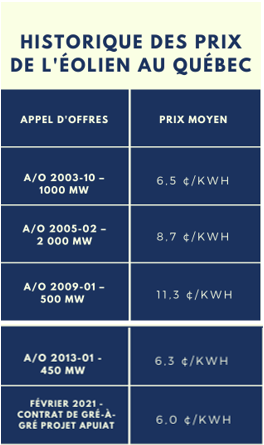
On February 4, the Legault government gave the green light to the Apuiat wind farm project. This 200-MW project, developed by the Innu communities of the North Shore and Boralex, will be built at a cost of 6.0¢/kWh—the most competitive price of any wind farm in Quebec.
We can therefore expect that the cost of wind energy in a potential wind energy tender in Quebec will also be among the lowest observed[13].
Over the past few months, the energy landscape, as well as the position and public statements of the Legault government and Hydro-Québec regarding wind energy, have evolved in a positive direction. The agreement reached with Massachusetts and the New York State authorities’ intentions to enter into a power purchase agreement with Hydro-Québec are game-changers, as are domestic needs to increase greenhouse production and the development of electric public transit projects and data centers.
Mr. Legault and Ms. Brochu made it clear during the launch of the Apuiat project that there will eventually be calls for bids to meet Hydro-Québec’s new needs. They also acknowledged that wind power is well-positioned to succeed.
On July 14, the Government of Quebec announced the adoption of a decree of concern addressed to the Régie de l’énergie (Régie) to present the government’s vision for the role of the wind power sector in Quebec’s energy mix in the coming years.
The decree is the first step toward Hydro-Québec launching a call for bids for new power supplies to meet long-term energy and capacity needs starting in 2026. According to the vision presented, the call for bids will include a 300-megawatt block reserved for wind power.
Here are the main highlights of the decree[14] :
The Quebec government has reiterated that, due to growing demand for electricity, the wind power sector will once again be called upon to meet Quebec’s energy needs, while additional calls for bids for renewable energy will be issued shortly. The projected additional demand by 2029 amounts to at least 1,400 megawatts and 1.5 terawatt-hours, a significant portion of which will be specifically allocated to wind power.
In light of these recent decisions and statements, industry stakeholders are looking forward with enthusiasm to the next phase of wind energy deployment and are offering their full cooperation on these new projects.
[1] https://www.quebec.ca/gouv/politiques-orientations/plan-economie-verte/
[2] https://canwea.ca/fr/marches-eoliens/quebec/
[3] https://canwea.ca/fr/marches-eoliens/quebec/
[4] Study of the Economic and Financial Impacts of Wind Farm Operations in Quebec, Aviseo Report, June 2018, page 9.[5] Same as above. Page 11
[6] Same as above. Page 12
[7] Same as above. Page 14
[8] Data as of November 10, 2020 [9] https://boralex-global.imgix.net/Rapport-intermediaire-T3-2020.pdf (page 6)[10] https://www.lazard.com/perspective/lcoe2019/
[11] https://www.irena.org/-/media/Files/IRENA/Agency/Publication/2019/May/IRENA_Renewable-Power-Generations-Costs-in-2018.pdf?la=en&hash=99683CDDBC40A729A5F51C20DA7B6C297F794C5D
[12] https://about.bnef.com/new-energy-outlook/
[13] Average wind energy prices do not include transportation and balancing costs
Sources : http://www.hydroquebec.com/4d_includes/la_une/PcFR2008-053.htm, https://www.newswire.ca/fr/news-releases/appel-doffres-visant-lachat-de-500-mw-denergie-eolienne-hydro-quebec-distribution-selects-12-bids-totaling-2914-mw-507213891.html, http://nouvelles.hydroquebec.com/fr/communiques-de-presse/697/appel-doffres-visant-lachat-de-450-mw-denergie-eolienne-hydro-quebec-distributionretient-3-soumissions-totalisant-4464-mw/, https://www.newswire.ca/fr/news-releases/partenariat-historique-avecla-nation-innue-le-quebec-va-de-l-avant-avec-l-important-projet-eolien-apuiat-de-200-mw-815468552.html
Stay up to date on the latest industry news by subscribing to our newsletter today.

Privacy policy ©2026 Nergica | Réalisation DACTYLO