
 See all news
 How to reach us
70 Bolduc Street, Gaspé, Quebec
Canada G4X 1G2
Nergica released the first in-depth study on the potential and role that solar photovoltaic (PV) energy can play in Quebec’s energy mix on May 13, 2021. This study highlights the successes and failures in Canada, Quebec, and elsewhere in the world, with the aim of developing recommendations on how to integrate the solar PV sector while taking into account the specific characteristics of the province of Quebec.
This reference work aims, in particular, to help structure the solar PV sector in Quebec and to develop a market and a value chain. The study is intended for policy and regulatory decision-makers, the solar photovoltaic industry, as well as researchers and potential users of solar technologies.
This study was made possible thanks to financial support from Economic Development Canada for the Regions of Quebec and aims to promote the energy transition. While photovoltaic solar energy is gaining ground around the world—the cumulative global capacity of solar PV installations accounted for nearly 23% of global renewable energy production in 2019—Quebec is lagging behind in adopting this technology. But the province has everything to gain!
At the launch, the study’s key findings were presented by the lead project manager, and thematic panels featuring 10 experts provided an opportunity to discuss the bright future of solar PV. Solar energy in Quebec continued to shine that afternoon during the Braindate networking sessions with several industry members.
Quebec has (solar) potential!
Although it may come as a surprise, Quebec enjoys sunlight conditions similar to those in Japan and Germany, which are global leaders in PV solar energy. The unique geographical characteristics of the province of Quebec, including geographically isolated regions such as Nunavik and the Magdalen Islands, present opportunities for installing solar panels to reduce the use of fossil fuels currently consumed by these off-grid regions.
Solar PV could therefore play an increasingly important role in Quebec’s energy mix, and to achieve this, Quebec must act now to create a favorable environment that will stimulate the development of the solar industry. This is an opportunity to create a value chain, as was done with wind power—especially since solar PV is becoming increasingly competitive.
In fact, « The cost of solar PV technology has fallen by 85% over the past 10 years, making it a competitive energy source and all the more attractive for Quebec. In fact, by 2030, solar power will have a cost comparable to, if not lower than, that of other renewable energy sources available in Quebec. » as Karim Belmokhtar, Senior Project Manager for Research and Innovation at Nergica, pointed out during the opening presentation at the study’s launch.
Solar power also has the advantage of being easy to deploy and operate, unlike other energy sources such as hydroelectricity or wind power, which require more complex logistics and infrastructure.
The study’s conclusion is clear: Quebec has significant untapped solar energy potential. As such, solar energy has a place in Quebec’s energy mix, and this is true across a growing number of sectors. This message resonated throughout the day and was reinforced and illustrated during the panel discussions featuring 10 experts.
Panel 1 – What role does solar energy play in Quebec today, and what does the future hold for it by 2030 et 2050?
Panelists:
– Philippe Dunsky, President, Dunsky Energy Consulting
– Gabriel Durany, President and CEO, Quebec Renewable Energy Production Association
– François Morin, Director of Development, Innergex
– Josée Pilon, Manager – Development Project Planning – Energy, Hydro-Québec

Against the backdrop of a projected energy shortage in 2026 and the energy transition, solar power offers significant potential. The panelists gathered for the study’s launch sought to stimulate discussion on the future of the solar photovoltaic sector in Quebec as one of the solutions for the energy transition.
According to Philippe Dunsky, solar power has not yet taken off in Quebec because the cost of electricity is currently low, there is no urgent need to invest in new technologies given the energy surplus, and the hydroelectric power generated in Quebec is already relatively green. Furthermore, wind power is more competitive in the short term. However, solar power is expected to gain a foothold in Quebec in the coming years.
François Morin is also convinced that solar energy holds great promise. He asserts that creating a value chain will be one of the challenges in the development of solar energy in Quebec. As Gabriel Durany pointed out, research still has a long way to go to consolidate the solar industry. Furthermore, the decline in PV module costs is a major boost for promoting solar energy and achieving the carbon neutrality goals set by governments. Gabriel Durany points out, however, that there is a lack of incentives and financial benefits to drive solar energy adoption in Quebec. Indeed, installation costs are a barrier for many, and the savings from self-generation are not yet compelling. The need to adapt Quebec’s regulatory framework was also raised.
According to Josée Pilon, there are two other major challenges that the solar industry will have to address in order to gain ground in the province and win over the public: the recycling of PV modules and social acceptance. These two issues have often been overlooked but deserve closer attention, according to Ms. Pilon, who coordinated the construction of Hydro-Québec’s solar power plants in La Prairie and Varennes. Another idea put forward by Josée Pilon is to focus on utilizing land such as roadside areas, zones near airports, and brownfield sites to install solar power plants.
Panel 2 – The Potential of Solar PV for Off-Grid Systems
Panelists:
– Olivier Arsenault, Engineer – Planning, Autonomous Networks Division, Hydro-Québec Distribution
– Jean-Michel Leblanc, Project Manager for Energy Efficiency and Development, Municipality of the Îles-de-la-Madeleine
– Yves Poissant, Research Manager and Senior Specialist – Solar Photovoltaic Technologies, CanmetENERGY, Natural Resources Canada
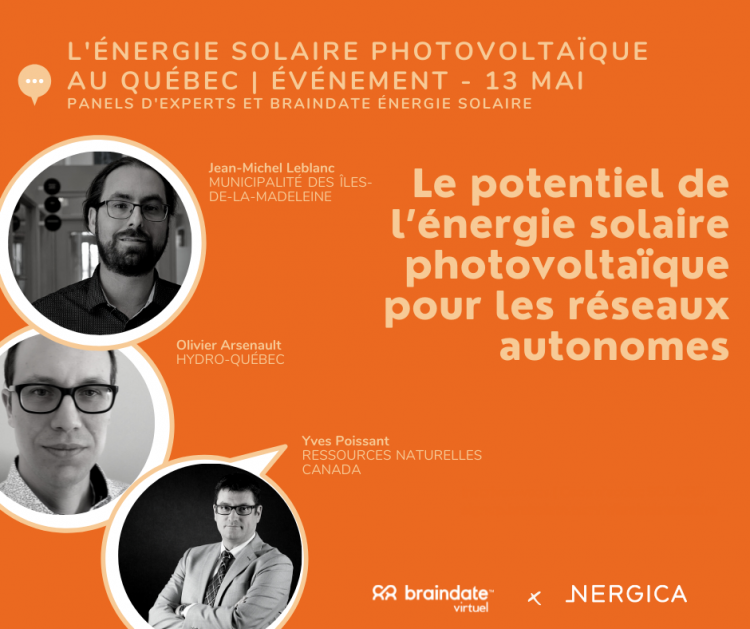
In remote areas, many communities rely on diesel-powered thermal power plants because they cannot be connected to the power grid. As a result, they produce approximately 223,000 metric tons of GHGs annually. The integration of solar energy is therefore particularly suitable and beneficial for such areas.
The three panelists highlighted the unique challenges of projects for off-grid networks, which are not always easy to manage and can present unexpected challenges. They emphasized that involving the community from the very beginning of the project is crucial. Jean-Michel Leblanc highlighted the vicious cycle that limits the installation of wind turbines and solar panels in remote areas such as the Magdalen Islands: the lack of skilled labor and the need to import materials slow down the implementation of these technologies. These unique challenges in carrying out projects in other remote regions were confirmed by the other panelists. However, the energy, environmental, and social benefits make these worthwhile challenges well worth tackling!
The lack of a solar market in Quebec explains the difficulty in accessing materials and the scarcity of personnel with the necessary expertise. Jean-Michel Leblanc and Olivier Arsenault have emphasized, however, that solar energy is well-regarded in Quebec. Nevertheless, certain challenges sometimes arise along the way, starting with the selection of land or rooftops for installing solar panels. This challenge takes on a whole new dimension in Nunavik, where many residents do not own their homes. Selecting suitable sites also poses a significant challenge, as they must meet numerous criteria, including sunlight exposure, terrain, necessary development work, and distance from residential areas.
The variability in output from solar (or wind) power plants, due to seasonality and weather conditions, means that storage systems are needed to replace fossil fuels in off-grid settings. « The cost of the facilities could then double », says Yves Poissant, who adds, however, that one of the advantages of solar power is its flexibility, and that the size of the system can be easily adapted to meet specific needs.
Panel 3 – Self-Generation of Solar PV Energy for the Residential and Commercial Building Sectors
Panelists:
– Patrick Goulet, President, Énergie solaire Québec
– Jean-François Jaimes, Director of Development and Renewable Energy, Énergir
– Mike Perrault, President, Rématek Energie
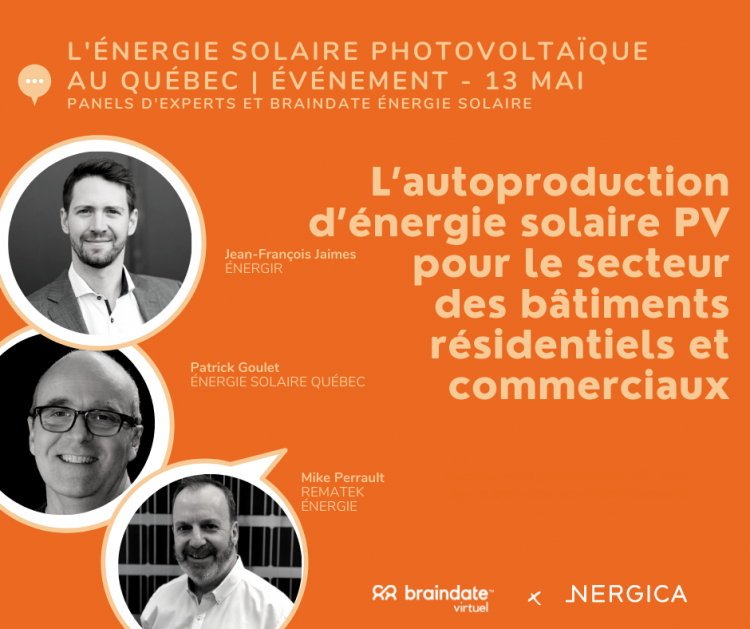
The global trend is toward the decentralization of energy production, as Jean-François Jaimes notes. The lack of financial incentives, such as tax credits, is a point that was repeatedly raised by many panelists. This lack of financial support is particularly acute for residential and commercial building installations, where the economic and environmental benefits of switching to solar power from grid-connected hydroelectricity are lower. Jean-François Jaimes also notes that competitive bidding processes could help enhance the solar value chain. PV solar energy will therefore gain popularity for residential and commercial applications, provided that module efficiency, storage, control, and management continue to improve, suggests Jean-François Jaimes.
Research also has its work cut out for it when it comes to installing PV modules on grid-connected buildings. Mike Perrault says that the first successes of solar energy in Quebec, such as the Varennes Library with built-in panels boost confidence and will thus spur other projects by removing barriers to the development of this technology.
This type of pioneering project also paves the way for further research and innovation to meet customers’ needs and requirements. That is why Patrick Goulet has turned the spotlight on building-integrated photovoltaic (BIPV) systems, whose costs are falling and which address numerous constraints and needs. He also advises potential future self-generators to contact Hydro-Québec at the very start of their project in order to plan their installation as effectively as possible and to learn about the opportunities and benefits available to them.
Solar energy is part of the solution in Quebec
This energy source is another tool for Quebec’s energy transition, as it offers significant economic and energy benefits in several areas, including the electrification of off-grid systems and residential and commercial self-generation.
Solar PV is set to grow in Quebec over the next few years and is an asset to the province’s energy mix. Furthermore, solar PV combined with hydroelectricity and wind power could enable Quebec to meet its target of reducing GHG emissions by 37.5% by 2030 compared to 1990 levels, and position the province among North America’s leaders in the field of renewable energy.
“Just start the machine and it’ll all work out!” as François Morin declared with enthusiasm and conviction.
——————————–
Study: “Photovoltaic Solar Energy in Quebec’s Energy Mix—Analysis and Outlook”
Recording of the three expert panels
Further reading:
A report concludes that Quebec would be wise to invest in solar energy – Le Devoir, May 2021
Quebec has no choice but to turn to solar energy – Journal 24h, May 2021
Solar Photovoltaics to Be as Competitive as Hydro-Québec by 2030 – Les Affaires, May 2021
Stay up to date on the latest industry news by subscribing to our newsletter today.

Privacy policy ©2026 Nergica | Réalisation DACTYLO