
 See all news
 How to reach us
70 Bolduc Street, Gaspé, Quebec
Canada G4X 1G2
Nergica participated in two events in Quebec and one across Canada in the renewable energy industry. Here’s a look back at the major trends and opportunities that caught our attention at the start of 2021.
by the Canadian Renewable Energy Association (CanREA)
26-January 27, 2021
According to Natural Resources Canada, the reliability of the electric grid remains a top priority for the federal government. To view the national strategy, funded projects, and federal funds available to ensure the cybersecurity of the electric grid, Click here.
Furthermore, in an era of prosumers, smart grids, and artificial intelligence, simply supplying energy is no longer enough. As Nicholas Miller of HickoryLedge LLC stated: “There’s nothing ancillary about ancillary services.”
Renewable energy sources are an integral and necessary part of electric grids, and ancillary services must be considered essential.
The issue of decommissioning wind and solar farms is becoming increasingly important, given the ever-growing number of renewable energy projects. To minimize environmental impacts, the construction of new wind and solar photovoltaic systems must be guided by circular economy principles to enable the reuse and recycling of raw materials, such as aluminum and steel. Some manufacturing companies, such as Vestas has implemented initiatives to effectively reuse manufacturing materials.
A Best Practices Guide for the Operation and Maintenance of Solar Farms (Version 4.0) was presented by SolarPower Europe. This guide covers topics such as planning, performance metrics, and best practices for effectively managing a solar photovoltaic plant.
According to Electricity Human Resources Canada and ENERCON Canada Inc.... In particular, training for technical staff in the wind energy industry must be improved to better meet companies’ hiring needs. Among the potential solutions being considered are increasing collaboration with CEGEPs and promoting the wind energy sector to young people to spark their interest.
As a college-level technology transfer center, Nergica rises to the challenge thanks to its
college and university internship programs and the hiring of skilled workers.
Some grants are available to help companies hire students and young workers:
According to Tom Rand of ArcTern Ventures, long-term energy storage is a market with very few players at the moment. The focus is more on short- and medium-term storage, particularly using batteries and flywheels.
Over the next few years, advances in autonomous monitoring systems—particularly drones—are expected. Advances in image-processing algorithms could help reduce the operating costs of solar farms, especially with regard to panel inspections.
Although there have been several discussions about the operational differences between wind farms and solar farms, the integration of multiple technologies (solar, wind, and energy storage) was not addressed during the Summit. While such commercial-scale projects have been underway in the United States for several years, they are now beginning to become feasible in Canada. Furthermore, at a time when utilities and governments are seeking to transition independent power systems to cleaner energy sources, projects to integrate renewable energy in remote areas are essential.
Nergica has published a white paper titled “Autonomous microgrids: A major asset for the electrification of off-grid sites"which we invite you to read to learn more about the development potential and challenges of integrating multiple technologies into microgrids."
To learn more about the Operation Summit
by Les Affaires
January 26, 2021
The 2030 Green Economy Plan (PEV), launched last fall by the Quebec government, is a cornerstone of electrification and the energy transition.
At the Energy Summit, several Quebec companies active in the clean technology sector presented their successes and challenges. The need to change the rules for competitive bidding emerged as a common issue. Indeed, the current practice of selecting the lowest bidder does not promote innovation or clean technologies.
In our view, if the life-cycle costs of equipment were better taken into account and the cost of a project’s environmental impact were assessed at its true value, this could change the overall analysis of submitted projects and have a significant impact on greenhouse gas (GHG) reduction targets.
There are already numerous programs, grants, and tax credits that encourage Quebec and Canadian companies to innovate and develop their expertise and intellectual property. These programs must continue and even be expanded if we want clean technologies to be competitive in the marketplace, whether in response to calls for proposals or in other contexts.
At this pivotal moment in the fight against climate change, the research and expertise communities will play a key role in the Green Economy Plan. This is a collective effort to which everyone must contribute. As a center for applied research and a catalyst for innovation, Nergica is ready to take on the challenge.
To learn more about the Green Economy Plan
by HEC Montréal
January 28, 2021
The latest edition of *The State of Energy* makes it clear: despite action plans and targets for reducing GHG emissions, GHG emissions in Quebec have stagnated and even increased over the past five years.
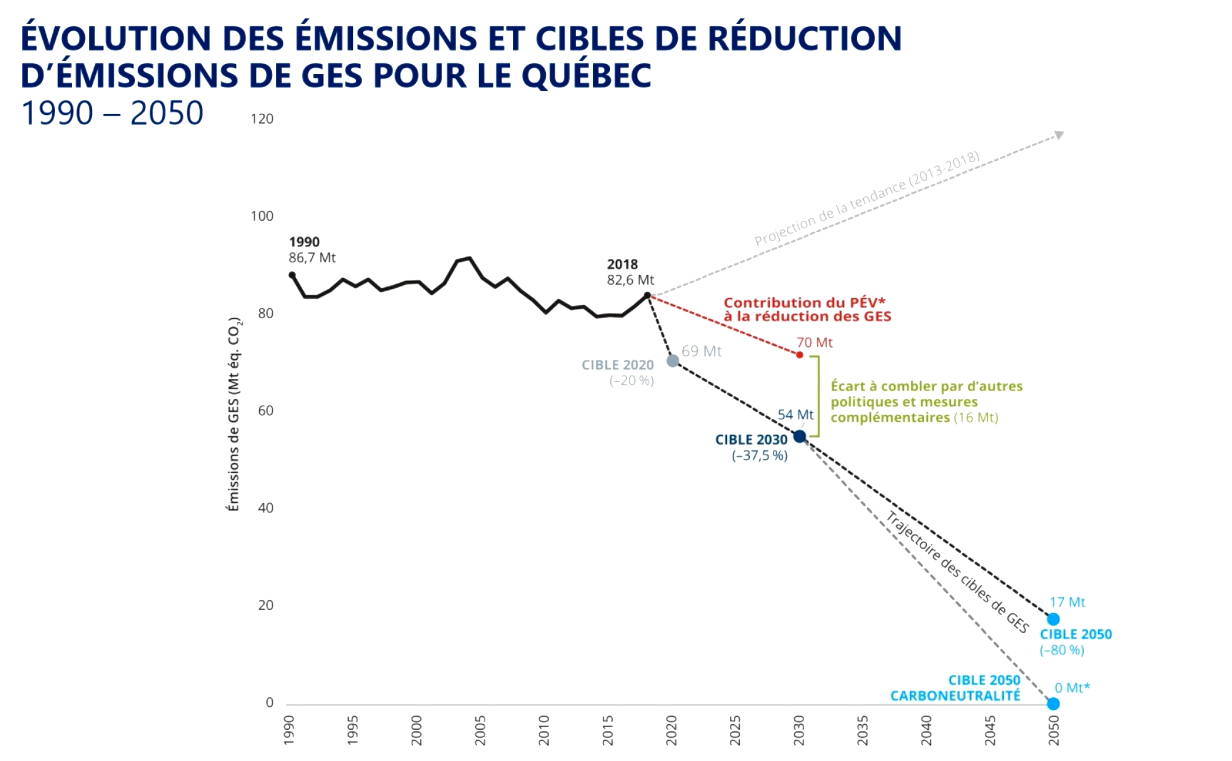
Reference: Whitmore, J. and Pineau, P.-O., 2021. State of Energy in Quebec 2021, Chair in Energy Sector Management, HEC Montréal, prepared for the Ministry of Energy and Natural Resources (Energy Transition Sector)). https://energie.hec.ca/wp-content/uploads/2021/01/EEQ2021_PPTLancement_28Jan2021_web.pdf
Consumption of petroleum products rose by 5% from 2013 to 2019, while GHG emissions increased by 3% between 2017 et 2018. Despite the pandemic, vehicle sales followed the trend of recent years, with a 284% increase in sales of SUVs and other light trucks. This type of vehicle accounted for 69% of total sales in 2019.
One piece of good news worth noting is that energy consumption in commercial and institutional buildings is declining. However, some of these gains are offset by the increase in floor area observed in the residential sector.
In terms of greenhouse gas emissions in Canada, Quebec ranks 3rde It ranks third with 83 million metric tons of GHG emissions, behind Alberta (273 million metric tons) and Ontario (165 million metric tons).
The authors of *The State of Energy in Quebec* have done a remarkable job, especially given the difficulty in accessing energy data. They have also highlighted the poor quality of this data in Quebec and Canada. The lack of comprehensive access—due to data that is often aggregated, classified as confidential, or sometimes even inconsistent—limits our understanding of the sector.
Nergica agrees that it is necessary to facilitate access to energy data in order to obtain an accurate and realistic picture of the energy situation. As a society, if we are to meet the various challenges of combating climate change, it is essential that leaders have access to reliable, detailed, and objective data in order to make the necessary decisions.
Stay up to date on the latest industry news by subscribing to our newsletter today.

Privacy policy ©2026 Nergica | Réalisation DACTYLO