
 See all news
 How to reach us
70 Bolduc Street, Gaspé, Quebec
Canada G4X 1G2
This Canada-wide series of interviews with energy transition experts provides an overview of the deployment of renewable energy in various regions across Canada and the measures being implemented to achieve carbon neutrality.
Here is the first installment in the series: a discussion on the energy transition in Quebec and the circular economy with Johanne Whitmore, principal researcher at the Chair in Energy Sector Management at HEC Montréal. Let’s start by reviewing the targets set by the federal and Quebec governments for reducing greenhouse gas emissions.
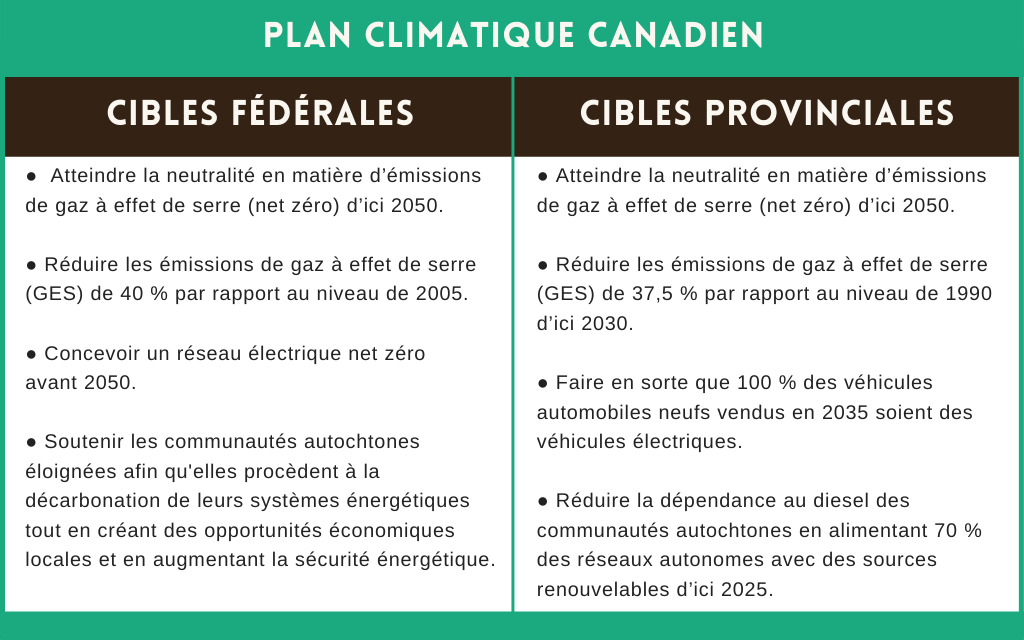
Reference: Pembina Report 2021: All Hands on Deck
Nergica: What does your research at the Chair in Energy Sector Management at HEC Montréal involve?
Johanne Whitmore : Established in 2013, the Chair is one of the first to be established at a business school to address issues related to the sustainable management of the energy sector. It aims to develop expertise on these issues from a sustainable development perspective, as well as to optimize energy sources and ensure they are aligned with society’s needs.
 My research focuses primarily on evaluating the effectiveness of energy and climate policies in achieving greenhouse gas reduction targets, as well as on strategies that promote the circular economy. The expertise developed within the Chair has led its members to serve on several committees, including Investissement Québec’s Industrial Innovation Committee, Fondaction’s Circular Economy Fund committee, and the Federation of Quebec Chambers of Commerce’s committee on energy and the environment. I am also a member of the Interuniversity Research Center for Organizational Analysis (CIRANO).
Nergica: Can you give us some examples of projects you're currently working on?
JW : The Chair contributes to public debate by publishing objective data and analyses to foster constructive dialogue among various stakeholders. For example, we publish the annual *State of Energy in Quebec*, a report summarizing the most recent and relevant data on Quebec’s energy system. We also organize, in collaboration with the Ministry of Energy and Natural Resources, workshops on various issues to spark a discussion on ways to accelerate Quebec’s energy transition and decarbonization. Our most recent workshops focused on environmental taxation, energy regulation, and the accessibility and transparency of energy data.
These issues are important for the renewable energy sector. Outdated regulations or a lack of data and communication are hindering the energy transition. Since conventional energy prices are often low, revising the tax and regulatory frameworks for the energy sectors will be essential to accelerate the deployment of renewable energy in the markets and ensure the profitability of Quebec’s renewable energy industry.
We are also concerned about the accessibility and transparency of energy data. In Canada, provincial data is often incomplete. This gap makes it difficult for industries, governments, and researchers to develop comprehensive overviews of the markets and to devise cost-effective solutions to accelerate the energy transition in Quebec.
Nergica: In your opinion, are Quebec’s environmental goals clear? And is it just as clear how we could go about achieving them?
JW : The target for reducing GHG emissions by 2030 is clear: 37.5% below 1990 levels. In the Energy Policy 2030, the government sets out five clear targets, including a 40% reduction in petroleum product consumption, a 25% increase in total renewable energy production, and a 50% increase in bioenergy compared to 2013.
What is less clear is the 2050 target announced in the Green Economy Plan. This plan aims for carbon neutrality—that is, reducing GHG emissions to zero or offsetting those that could not be reduced. The government must specify—which it has not yet done—how it will define and account for offset reductions in its GHG inventories to avoid double counting. It must also avoid a situation in which no reductions could be calculated or offset. The government must therefore, as a matter of priority, define offset reductions and establish accounting methods.
Nergica: What are the main challenges facing Quebec's energy transition right now?
JW: The biggest challenge is inertia. Quebec’s energy profile is already significantly decarbonized compared to that of other regions, as Quebec relies heavily on hydroelectric power. This may lead Quebecers to believe they have already done their part in the fight against climate change. However, the reality is that Quebecers consume more energy per capita than people in other regions, particularly in the United States. In 2018, Quebec consumed 224 GJ per person, while the United States consumed 201 GJ per person! Our consumption of petroleum products—primarily for transportation—has been rising by 5% since 1995. Furthermore, our GHG emissions have been stagnant since 2010. We are therefore far from being in the clear when it comes to meeting our targets.
Quebec developed its hydroelectric resources in the 1960s because they were abundant, not because they were “green.” By ensuring greater energy independence and security for Quebec, the government promoted the province’s economic development. Today, this combination of factors gives us a head start over our neighbors in the fight against climate change.
 Quebec therefore has a responsibility to seize this opportunity and demonstrate leadership in the energy transition. If Quebec cannot successfully navigate the transition with such an abundance of clean, low-cost energy, it will be hard to imagine that other regions will be able to do so! This presents an opportunity to turn Quebec into a testing ground for developing innovative business models and technologies, rolling out pilot projects, and devising new approaches to energy management and efficiency to ensure the profitability of these innovations.
Nergica: Since Quebec’s electricity has been green for so long and there’s room for innovation, what’s holding back the development of more wind and solar projects in Quebec?
JW : One of the challenges is the lack of economic efficiency and transparency in Quebec’s electricity market. Prices are controlled by the Régie de l’énergie, which can be influenced by political interests, thereby stifling competition and innovation. The Régie’s consideration of environmental factors and factors related to the energy transition in its decisions can also be arbitrary. This situation contrasts with that of New York State, which has adopted a major reform to restructure its electricity market and now benefits from new, more economical and greener generation options that offer consumers greater choice, thereby giving them access to a more competitive market.
The Quebec government has also increasingly turned to incentives to fund innovation, such as the “Roulez vert” program for the purchase of electric vehicles. However, to transform our markets and promote renewable energy, we will need to use other tools, such as tax measures, regulatory reforms, and public awareness campaigns.
Nergica: So the energy transition isn't being slowed down by technological or resource-related issues, but rather by political ones?
 JW : Indeed, we must stop politicizing the Climate Change Electrification Fund (FECC, formerly the Green Fund) so that its governance is independent of ministerial offices and its management is more transparent. Bill 44 falls far short of meeting these two basic criteria. A model to follow is that of the United Kingdom government, which passed legislation to create an independent Climate Change Advisory Committee (UK CCC). This committee has a clear mandate and receives dedicated annual funding to prevent any political interference in the fight against climate change. The committee evaluates government action plans, publishes recommendations and analyses, and monitors the measures implemented by each ministry to achieve the overall objectives.
Nergica: Quebec therefore still has a long way to go in its energy transition, even though hydropower has accounted for the vast majority of its energy mix for decades now. According to the report The State of Energy in Quebec According to a report published by your Chair in January 2021, 94% of the electricity generated in Quebec in 2019 came from hydroelectric sources, 5% from wind power, and less than 1% from biomass and diesel. Given this context, isn’t it difficult to significantly reduce GHG emissions by 37.5% by 2030, as the government hopes to do?
JW: Overcoming the climate crisis will depend more on how we consume energy than on where it comes from. Access to increasingly efficient energy sources has enabled humanity to accelerate the transformation of resources into goods and has fueled global economic growth. In terms of energy, we moved from biomass to coal in the 18th century, then to oil and natural gas in the 20th century. Hydrocarbons now account for nearly 90% of humanity’s energy needs. The transition that scientists are urging us to begin aims to avert an ecological catastrophe by replacing highly efficient energy sources (hydrocarbons) with sources that are often less efficient (renewable energy). This therefore involves moving in the opposite direction of the historical trend.
While fossil fuels are now humanity’s primary source of energy, replacing them with less efficient and often more expensive energy sources will be impossible without radically changing consumption patterns. To achieve this, the top priority must be to reduce total energy consumption. Only then will it be possible to offset GHG emissions or minimize whatever remains of hydrocarbon consumption by using energy sources that emit fewer GHGs—biofuels, solar, wind, and green hydrogen. However, these energy sources are more expensive in some cases, and their energy efficiency is lower than that of oil.
The energy transition is, first and foremost, about consuming more wisely. This is a point I emphasize in a chapter of the book *Thirty Common Misconceptions About Sustainable Development*.
 The good news is that we have the resources to match our ambitions: humanity has never had so much wealth and surplus energy at its disposal. All that remains is to harness our imagination to build an economy different from the one we have known for so long.
Nergica: One of the findings presented in your report is energy loss in Quebec and the fact that average per capita energy consumption there exceeds that of the United States. Yet when we hear the discourse in various social, political, and economic circles in Quebec, people seem to pride themselves on being environmentally friendly and doing better than our neighbors. What do you think explains this situation?
JW : Generally speaking, the cheaper energy is, the more we consume. This is certainly the case in Quebec, which explains why we rank at the bottom in terms of per capita energy consumption. However, abundant and inexpensive electricity has also helped attract major industries that have contributed to Quebec’s economic development, such as the aluminum, cement, and steel sectors. In fact, the greatest energy losses come from the transportation sector—both passenger and freight—due to the inefficiency of vehicles. Certain industrial sectors also experience significant energy losses, but competition and social pressures are driving them to improve. Furthermore, a significant portion of these sectors’ emissions is not related to energy consumption but to industrial processes. It is therefore up to them to review their processes to improve energy efficiency.
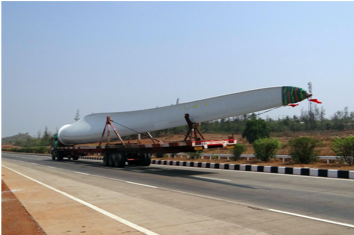 It is also worth noting that simply being part of the renewable energy sector—as a producer, supplier, distributor, or manufacturer—does not automatically qualify a company as “green.” It is important for companies in the renewable energy sector to consider their impact across the entire value chain of their products or services. Several resources in Quebec—both government and private—are now available to support organizations in adopting a circular economy approach. This approach ensures not only better environmental performance but also economic performance due to productivity gains.
Nergica: We often hear companies based in Quebec claim that their carbon footprint is better than that of companies located outside Quebec, since our electricity is green. I suppose that’s a first step…
JW: Ultimately, companies must aim for a transition to a business model based on circular economy strategies that enable efficient resource management. The linear model—extraction, production, consumption, and disposal—has become so inefficient that it is increasingly costly for society and businesses to maintain. It is possible to improve both economic and environmental performance by revising business models with a view to optimizing and improving energy and resource productivity. Including circularity indicators in corporate performance reports and decision-making processes will help align economic performance with environmental performance.
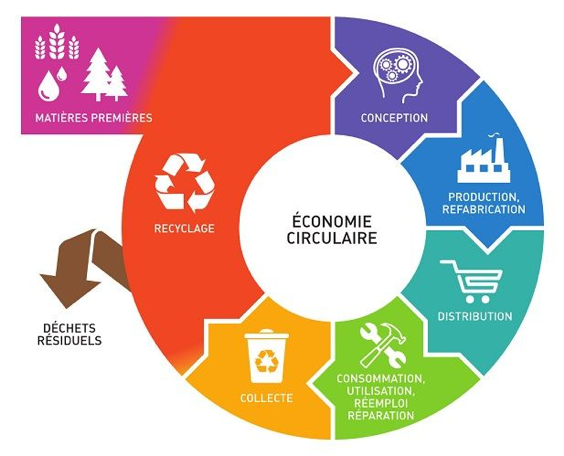
A Schematic Representation of the Circular Economy
Nergica: One recurring point that stands out to me is that we need to be more proactive! We need to consume less; we need more relevant data to make better predictions; and we also need more analysis early on. We need to think about recycling before we manufacture, not just when we’re backed into a corner, and so on.
JW: Indeed, in Quebec, many wind turbines will reach the end of their life cycle in about 25 years. If we can recover the parts or infrastructure, it’s a win-win both environmentally and economically. Electric car batteries are also a good example. Quebec is investing in the development of lithium-ion batteries and seeks to position itself as a leader in this field. This will help reduce transportation-related GHG emissions and also create jobs. However, from the outset, we need to establish circularity standards and criteria for mineral extraction, which would help reduce the environmental footprint of battery production.
This interview was conducted as part of a series of regional profiles on renewable energy in Canada. To hear the views of other experts and stakeholders in the energy transition, join us at Transition Solutions Symposium on October 14, 2021 and register now. This Canada-wide event focuses on the technological, social, and policy innovations needed to implement renewable energy in Canada and advance the energy transition.
Another publication in the series:
More coming soon!
Stay up to date on the latest industry news by subscribing to our newsletter today.

Privacy policy ©2026 Nergica | Réalisation DACTYLO