
Green Revolution: Recycling Wind Turbine Blades Is Transforming the Industry
 See all news
 The project
Fibecycle, in collaboration with Nergica, recently conducted a detailed study on the carbon footprint of wind turbine blades throughout their life cycle. This partnership highlights the positive impact of recycling the composite materials used in wind turbines, offering an innovative solution to reduce waste and promote a sustainable future.
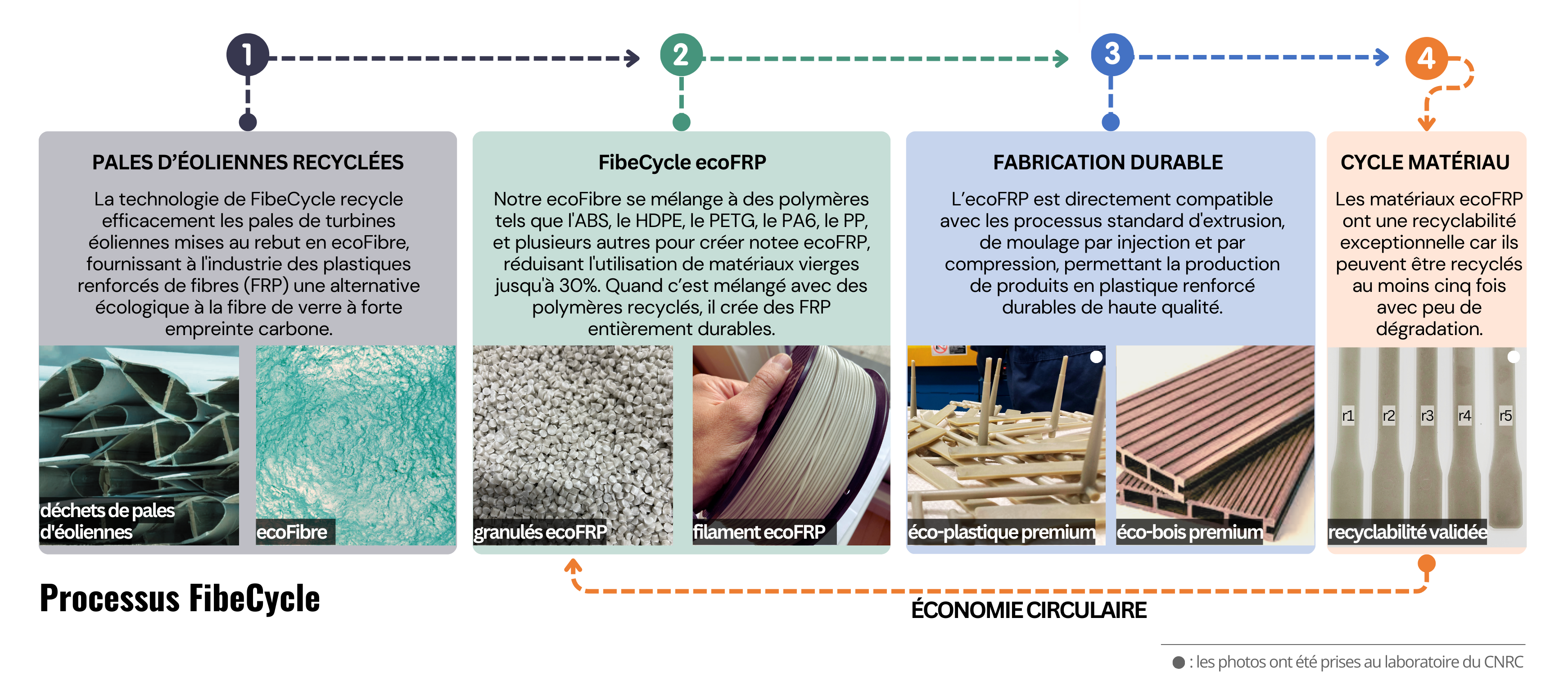
FibeCycle demonstrates that wind turbine blades can be transformed into new eco-friendly resources. “At FibeCycle, we often say that we’re changing the way we view wind turbine waste. Once considered non-recyclable, the blades are now successfully recycled thanks to our innovative processes. We’re not just innovating; we’re demonstrating that recycling wind turbine blades is not only feasible but also highly effective,” explains Cesar Patricio, co-founder and CEO of FibeCycle. “Our exclusive and innovative recycling process is designed to scale with demand and efficiently process large volumes of discarded wind turbine blades. ” The blade recycling process developed by FibeCycle involves a shredding procedure followed by a sophisticated fiber sorting stage, transforming the blades into high-quality recycled glass fibers. These fibers are then used to create eco-friendly fiber-reinforced polymers (ecoFRPs[1]), thereby enabling the industry to manufacture sustainable products while reducing reliance on virgin materials.
Photos of the FibeCycle process show how discarded blades are transformed into eco-friendly materials.
Challenges
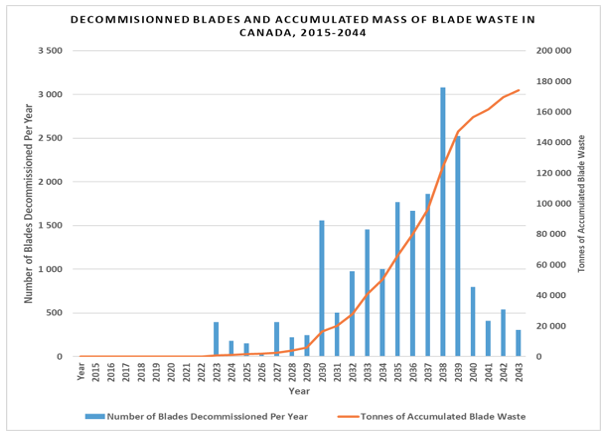
The figures are striking: Approximately 174,000 metric tons of wind turbine blade waste will be generated in Canada over the next 20 years. Forecasts show that blade waste production will peak between 2036 et 2040, reaching a potential high of 29,000 metric tons per year in 2038. Without an effective recycling solution, this amount of waste will ultimately exacerbate environmental problems. FibeCycle’s technology thus offers a concrete alternative by promoting the circular economy and reducing the wind power industry’s overall carbon footprint. With the growing number of Canadian wind turbines reaching the end of their useful life, it is essential to implement sustainable solutions to recycle and reuse blade materials within the framework of a circular economy.
Solutions
A typical 1.5-MW wind turbine contains about 23 metric tons of blade material, primarily fiberglass, resin, and adhesives. According to research by the Nergica team, a wind turbine generates a significant energy footprint throughout its life cycle, equivalent to 646 gigajoules (GJ) of energy. This amount of energy is enough to power the Christmas lights in a small town during the holiday season. This process also results in a carbon footprint of 33.8 metric tons of CO2 equivalent, with 89% of emissions occurring during the manufacturing phase.
FibeCycle aims to turn this challenge into an opportunity by offering a viable recycling solution, thereby reducing carbon emissions and promoting environmental sustainability.
Highlights
- FibeCycle and Nergica have identified the significant carbon footprint of wind turbines, highlighting the need for recycling solutions.
- The FibeCycle process transforms the blades into high-quality recycled glass fibers to create eco-friendly polymers (ecoFRPs).
- By 2038, Canada is expected to decommission approximately 3,081 wind turbine blades, generating more than 29,000 metric tons of blade waste. Without a recycling solution, this waste could have a devastating environmental impact.
- FibeCycle's approach reduces reliance on virgin materials, thereby promoting a circular economy in the renewable energy sector.
- Recycling wind turbine blades supports the commitment to green energy and reducing CO2 emissions, thereby addressing a major environmental challenge.
