
 See all news
 How to reach us
70 Bolduc Street, Gaspé, Quebec
Canada G4X 1G2
Icetek is a Quebec City-based company that develops technological solutions for wind power in northern climates. Its products are designed for wind farm operators facing production losses due to ice buildup. Ice affects the aerodynamic performance of a wind turbine’s blades, thereby reducing its electricity generation. Given that the winter months are the windiest of the year and that the air is denser due to cold temperatures, ice can cause up to a 25% loss in annual power generation for a wind farm.

An example of ice buildup on a wind turbine blade, as observed at the Nergica research site.
Icetek originated from a doctoral research project at Laval University in 2012. André Bégin-Drolet, co-founder of Icetek, was working on a wind sensor capable of detecting traces of ice. From this project emerged the idea of developing an ice detection system for wind farms.
Icetek is therefore a spin-off from Laval University that was launched in 2020. Today, the company markets its ice detection system, called IC-1, and has six full-time employees and three part-time employees.
The company is now in a phase of rapid growth; already established in Eastern Canada and the United States, it is seeking to expand into new markets, including Western Canada, the rest of the United States, and, soon, Europe.
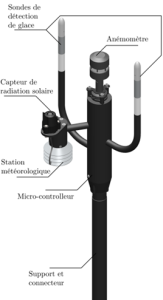
The various components of Icetek's IC-1 sensor
The Ice Condition Monitoring System (IC-1) is, in short, a sensor that detects conditions leading to icing. In fact, it is not just a detector, but a complete weather station that measures wind speed and direction, temperature, pressure, relative humidity, and solar radiation. The weather station is also equipped with two patented sensors that feature technology unique to Icetek.
Liquid water content, or Liquid Water Content, is defined as the mass of liquid water contained in one cubic meter of air. It is used to classify the type of ice (black ice, white frost, clear frost).
What makes this detection system unique is that the sensors can measure the liquid water content of the air, or LWC (Liquid Water Content). Measuring LWC, combined with other meteorological data, makes it possible to identify the conditions causing icing, the start and end of the episode, as well as the intensity of the icing event.
With the IC-1, it is possible to predict how and at what rate ice will accumulate on surrounding structures. It is also possible to identify the type of ice and measure the thickness of the ice accumulated on the surface. The detection signal can then be integrated into the wind turbine’s controller or its de-icing system to significantly reduce the impact of ice on the turbine’s power output.
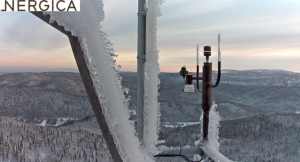
Icetek's IC-1 sensor during a frost event at the Nergica research site.
To date, most ice sensors measure either the presence or the accumulation of ice. This is what sets the IC-1 apart: it not only detects ice accumulation but can also identify its cause. For example, it can indicate that freezing rain is the cause of ice on the blades.
Identifying the cause of icing allows for faster detection than other sensors on the market, which is highly beneficial for wind farm operators, as it enables them to activate de-icing systems before ice builds up. In other words, the sensor indicates the presence of conditions leading to ice buildup before it negatively affects wind power generation, enabling a proactive approach.
Finally, the detection system developed and patented by Icetek—which measures the liquid water content in the air—makes it possible to identify the type of ice detected (white ice, transparent ice, black ice, etc.). This system is one of the few on the market capable of achieving this result.
Some of Icetek’s customers use the detection system to activate wind turbine de-icing systems: the monitoring system detects ice as early as the initial stages of an icing event, thereby triggering the wind turbine’s de-icing systems. This reduces a wind turbine’s loss of power output during icing events.
Other customers use the ice detection system without having de-icing systems installed on their wind turbines. The idea is to perform a preventive shutdown so that the wind turbines do not rotate, which reduces ice buildup and allows for a faster restart when weather conditions improve. The sensor that detects when icing conditions have ended also ensures that the turbines restart under optimal conditions.
The solution developed by Icetek is also designed for customers with wind turbines located near residential areas or places frequented by the public. In the event of icing, the detection system will shut down the wind turbines before ice accumulates in large quantities, thereby protecting the public by preventing ice from being thrown off the blades.

The Caribou Wind Farm in New Brunswick.
The first project The largest-scale project in which the IC-1 sensor was used is the Caribou Wind Farm, not far from Bathurst, New Brunswick. Half of the wind turbines at this farm were equipped with the system. The project significantly improved the detection system: the system was upgraded from a dome-type anemometer to an ultrasonic anemometer, and the various sensors were then integrated into a single system.
Since the project began, IC-1 has been used in more than 25 other wind farms and is now a detection system capable of controlling a wind turbine. It is an integral part of the system, enabling the activation of de-icing systems or shutting down the wind turbine at the right time.
Wind turbines in cold climates operate in harsh conditions characterized by wide temperature fluctuations throughout the year, electrical disturbances, falling ice, and vibrations. Technology development projects have made it possible to redesign the ice detection system so that it effectively meets the demands of this environment.
Icetek has developed a software solution called IceBrain to use data from the IC-1 to optimize production strategies.
Development work is also underway to enable data collection using an IC-1 mounted on a mast. In this case, the sensor does not move with the wind direction, unlike when installed on a wind turbine. The next step will be to test the product on weather masts, in collaboration with Nergica. One area for optimization is improving the product’s heating performance: the detection system can consume up to 300 watts, which is negligible for a wind turbine but not for a weather mast.
In the future, IC-1 will be designed to equip wind farms located in cold climates in North America, as well as in Europe, where wind power is in high demand. Above all, however, Icetek aims to initiate discussions with wind turbine manufacturers to integrate this detection system into the turbines during the construction phase. To this end, Icetek aims to install systems in collaboration with major wind turbine manufacturers in the fall of 2024 and the summer of 2025. This will allow the company to demonstrate the effectiveness of its technologies by comparing them to other sensors on the market.
And feel free to contact us about your projects.
Stay up to date on the latest industry news by subscribing to our newsletter today.

Privacy policy ©2026 Nergica | Réalisation DACTYLO