
 See all news
 How to reach us
70 Bolduc Street, Gaspé, Quebec
Canada G4X 1G2
Solar Photovoltaics (PV) is attracting more and more attention in Quebec, and the future looks promising for this type of energy. In fact, Hydro-Québec has inaugurated its two solar power plants located in La Prairie and Varennes in June 2021, and the Lac-Mégantic microgrid, which was also launched in collaboration with Hydro-Québec, has been in operation since June 2021. Quebec’s expertise in solar energy is really shining right now, even though the installed capacity in the province is still limited.
Many companies realized several years ago that investing in solar energy was a wise move. Some have therefore created new divisions dedicated to renewable energy—and, in some cases, specifically to solar energy. In this way, they are contributing to the growth of the solar industry in Quebec and around the world.
Among these companies: Rematek Energy, Saint-Augustin Canada Electric Inc. (Stace), WSP and Kruger Energy.

Rematek Energy
Rematek Énergie has been involved in renewable energy since 2009. This wholesaler of solar panels, solar batteries, inverters, and installation accessories—such as solar trackers, mounts, rails, and more—operates on a global scale. The company, which has a logistics center in the United States and an office in Mexico, is known for the availability of its products and its teams, as well as for its attentive customer service.
The quantity and variety of products the company offers are among Rematek Énergie's strengths. Inventory availability However, it poses a major challenge, according to its president, Mike Perrault.
The first net-zero project completed in Quebec—the Varennes library in 2014—propelled Rematek Énergie into the spotlight. The company then equipped the cottages in the Quebec Outdoor Recreation Association (Sépaq), as well as the Maison Simons in Quebec City, the Central Bank of the Republic of Guinea, and the PHÉNIX building (Lemay project). Thanks to this experience in commercial and industrial installations, Rematek Énergie can provide valuable expertise to engineering consulting teams. Since 2020, the company has also been exploring the combination of photovoltaic and solar thermal systems, a trend that is regaining momentum.
Rematek Énergie maintains close relationships with about 100 installation partners, to whom it offers training, technical advice, and a sizing service in French. Its Partner+ program allows installers and engineering firms to benefit from technical assistance and advice from start to finish of a project, for example regarding feasibility studies or design support. This program enables Rematek Énergie to provide its customers with support tailored to their specific needs.
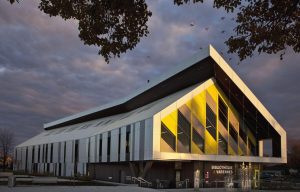
Photo: Stantec. Varennes Library
Saint-Augustin Canada Electric Inc. (Stace)
As a leading supplier of solar modules in the market for busbar assemblies and auxiliary electrical equipment solutions, Stace has acquired other companies over the years, thereby expanding its expertise in the manufacturing and installation of solar modules.
In 2015, Stace acquired GE Canada Saint-Augustin and entered the solar energy market. In 2016, the company acquired the Concentrix solar technology developed by Fraunhofer Institute for Solar Energy Systems, a research center located in Germany. In 2017, it opened its first solar panel factory in Trois-Rivières. The acquisition of a conventional solar module production line in Ontario—which it subsequently relocated to Trois-Rivières—enabled the company to begin producing innovative concentrated solar power modules as well as monofacial and bifacial solar modules. As for the Saint-Augustin-de-Desmaures plant, it continues to focus on its original mission: the design and manufacture of medium-voltage equipment.
The acquisition of the French company SO-TEC strengthens Stace’s expertise in solar power plant installation and enables it to be involved in all stages of a project—from design and manufacturing to product installation. This results in optimized equipment, enabling the company to meet its customers’ needs and fulfill their requests.
More than 90% of the products Stace manufactures in Quebec are exported worldwide, primarily to major electricity producers such as Southern California Edison, Électricité de France (EDF), Saudi Aramco, the Tennessee Valley Authority, and Bruce Power, as well as project developers such as ENGIE, VINCI, and Invenergy.
In addition to relying on a global supply chain, the company benefits from the presence in Quebec of several suppliers of raw materials—aluminum, copper, steel—as well as the presence of some 50 subcontractors in the fields of logistics, machining, and mechanically welded assembly. This is an undeniable advantage, according to President and CEO Normand Lord.
Innovation and the introduction of new products are central to Stace’s mission, and through its partnership with the University of Sherbrooke, the company is constantly developing and improving its solar technology. Its solar modules feature the world’s lowest carbon footprint—even lower than Norway’s—thanks to the green energy the company uses in Trois-Rivières.
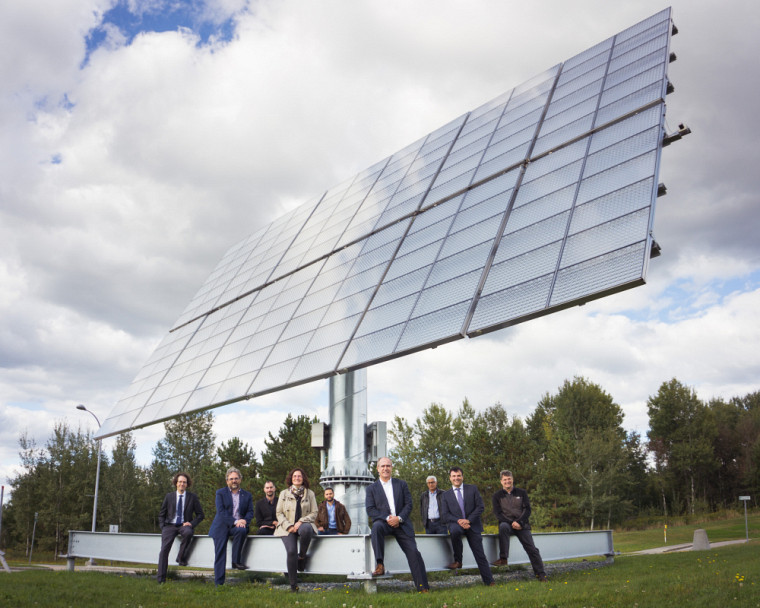
Photo: University of Sherbrooke. Members of the university’s research team with representatives from Stace.
WSP
WSP is an engineering consulting firm formerly known as GENIVAR, which has grown rapidly since its founding in 1959 in Quebec City. The expertise of its staff in the field of the built and natural environment is recognized worldwide. Since 2009, WSP has shown an interest in solar energy and has been involved in energy modeling, electrical system design, and the construction of foundations to support the equipment needed to carry out several projects. In 2016, the company established a division dedicated to solar energy. Thus, its existing divisions—transportation, electricity distribution, hydropower, and wind power—were joined by a new sector focused on energy storage and microgrids.
WSP assisted Hydro-Québec in implementing the microgrid project in Lac-Mégantic. It provided the technical consulting services required to evaluate the microgrid installation and assess the technologies used in smart cities to understand and address all potential needs. At the request of Borea Construction, WSP also carried out the detailed engineering for Hydro-Québec’s solar power plant projects in La Prairie and Varennes.
Elsewhere around the world, WSP teams have carried out projects for a variety of clients, including governments, utilities and energy companies, developers, energy suppliers, and energy producers, among others. The Canadian teams are based in Quebec—Montreal, Quebec City, and Sherbrooke—as well as in Alberta, Ontario, and British Columbia. WSP’s solar energy sector has experienced rapid growth in Canada and continues to build on that momentum. While it had fewer than five employees in 2016, it now—just five years later—employs more than 45 people, according to Alexandre Pépin-Ross, who until very recently served as market leader. National, Solar at WSP and a member of the board of directors of the Quebec Association for Renewable Energy Production (AQPER).
Among WSP's strengths are its global expertise, local presence, adaptability, and ability to innovation and the quality of its work. Over the past three years, WSP has achieved success around the world by tailoring its unique solutions to the local conditions of its client countries. In Quebec, WSP is able to offer solutions tailored to the specific characteristics of the terrain and climate, making it possible to generate energy at a cost as low as that of wind power. WSP’s teams work closely with local engineering firms and Hydro-Québec to promote their solutions, which are perfectly suited to the realities of Quebec.
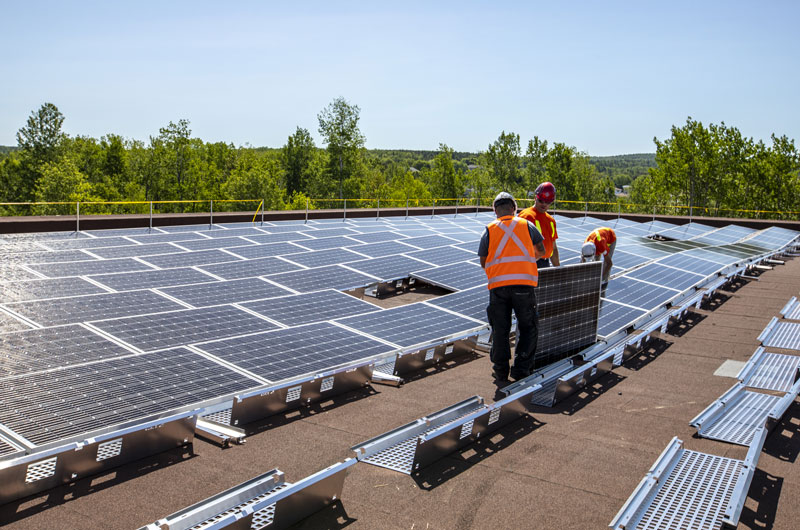
Photo: Hydro-Québec. Installation of 1,700 solar panels on the roof of the sports center in Lac-Mégantic.
Kruger Energy
Kruger Energy operates 42 renewable energy generation sites with a total installed capacity of 542 MW. These sites include hydroelectric and biomass cogeneration plants, wind farms, as well as solar power and energy storage facilities. In addition, the company is working on projects that will generate more than 500 MW.
Following the installation of its first solar power plant in California in 2015, Kruger Energy has continued its operations in the United States. The Foxtail Grove Solar Energy Project (10 MW), carried out in partnership with SaskPower, is expected to be completed by the end of 2021 and will supply power to approximately 26,000 households in Regina. Given its size, Kruger Energy develops smaller-scale projects in a niche market overlooked by larger players.
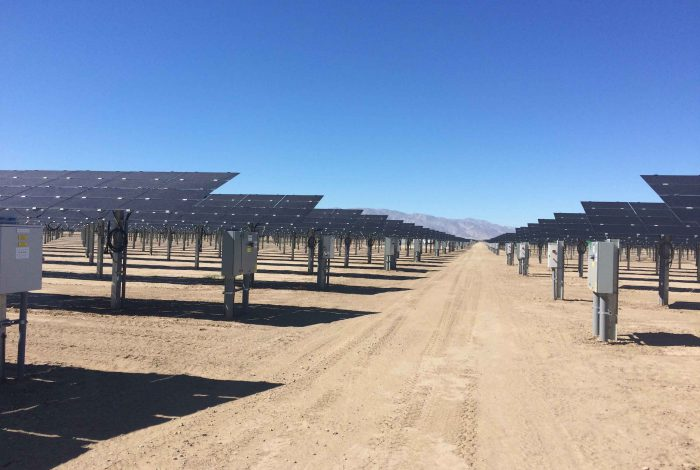
Photo: Kruger Energy. Seville Solar Farm in Borrego Springs, California (50 MW).
Social responsibility is at the heart of Kruger Énergie’s mission. The company strives for social acceptance, as it aims to be an integral part of the communities that host it over the long term. The company’s executives are delighted with the Social Acceptability Award it received for its Kruger Énergie Montérégie (KÉMONT) wind farm, presented by the Canadian Wind Energy Association in 2014.
To learn more about photovoltaic solar energy and its role in global, Canadian, and Quebec energy production, see the study Photovoltaic Solar Energy in Quebec’s Energy Mix – Analysis and Outlook, produced by Nergica. It highlights the successes and failures of the solar industry in Canada, Quebec, and elsewhere in the world, and offers recommendations on how to integrate the solar PV industry into Quebec while taking the province’s specific characteristics into account.
Coming soon: Interviews with representatives from Kruger Énergie, Rematek-Énergie, Stace, and WSP about the growth of the photovoltaic sector in Quebec and the few obstacles limiting the development of the solar industry.
Stay up to date on the latest industry news by subscribing to our newsletter today.

Privacy policy ©2026 Nergica | Réalisation DACTYLO