
 See all news
 How to reach us
70 Bolduc Street, Gaspé, Quebec
Canada G4X 1G2
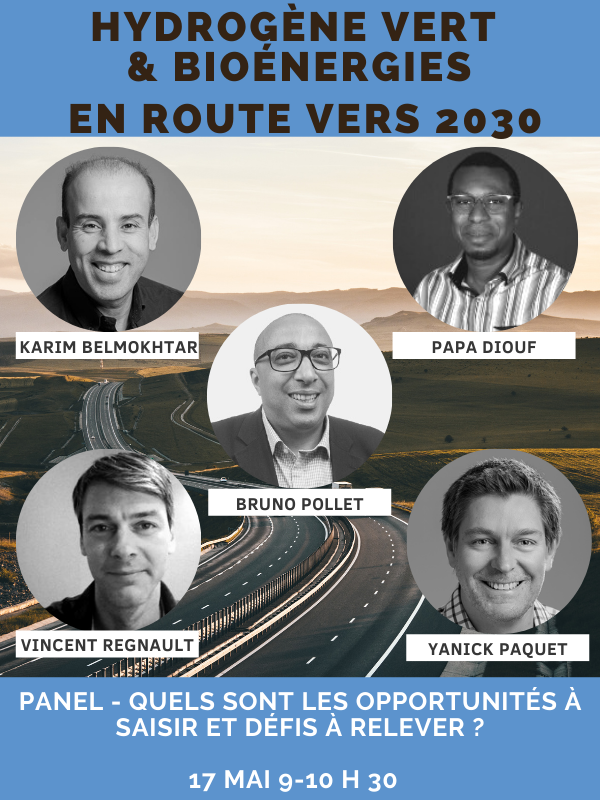
“The strategy on green hydrogen and bioenergy that we expect from the government—I think it will align us with the priorities for developing this sector,” was the first response from the Vincent Regnault, Director of Gas Procurement and Renewable Gas Development at Énergir during the panel titled Green Hydrogen and Bioenergy: On the Road to 2030 which took place on May 17.
As part of Green Economy Week, nearly 100 participants, along with key players in the green hydrogen and bioenergy sectors, gathered for the panel discussion. Green Hydrogen and Bioenergy: On the Road to 2030 Organized by Nergica in collaboration with CITEQ-FRQNT (Catalyst for Innovation in Quebec’s Energy Transition). The discussions focused on the challenges to be addressed and the opportunities to be seized in order to embed these technologies in Quebec’s ecosystem over the next decade. This panel echoes the consultation on Quebec’s strategy conducted by the Ministry of Energy and Natural Resources.
 Technologies Awaiting Deployment
The panelists were first asked by moderator Alexandra Gellé, a knowledge mobilization officer at Nergica and a member of CITEQ, about the key factor for these technologies to establish themselves in the market. The responses were unanimous, identifying the Quebec government’s stance as essential for creating a value chain and an economic model, thereby promoting the development of the bioenergy and green hydrogen industries.
You will therefore understand that the findings of the consultation launched by the Ministry of Energy and Natural Resources in 2021—which led to the submission of 30 briefs by various experts in these sectors—are eagerly awaited. This Quebec strategy will help position the province and set targets, which should stabilize the market and thereby attract the investments needed to deploy these technologies on a large scale.
Among the key takeaways from this panel discussion, we note that neither the maturity of these technologies nor their current cost appears to be a barrier to the integration of green hydrogen and bioenergy by 2030. In fact, the panelists interviewed seemed confident that the costs associated with these technologies will be competitive enough to enrich Quebec’s energy mix—particularly when taking the carbon tax into account, as explained by Yanick Paquet, a researcher at Nergica. Cost parity between green hydrogen and gray hydrogen could could be achieved by 2030, according to the Hydrogen Insights Report (2021) by the Hydrogen Council and McKinsey & Company.
Bruno Pollet, director of the Hydrogen Research Institute and professor at the Université du Québec à Trois-Rivières, points out that it would be worthwhile to investigate Quebec’s metal resources to determine the most promising types of electrolysers for the province, as well as assessing their efficiency. For example, the Air Liquide plant in Bécancour, with its electrolyzer that proton exchange membrane of 20 MW (currently the world’s largest) produces approximately 3,000 metric tons of green hydrogen annually, and the shydrogen strategy published by Natural Resources Canada forecasts a demand of 20 megatons by 2050.
The utilization of forest-derived biomass as a means of producing hydrogen, as well as methane and biofuel, was discussed by Papa Niokhor Diouf, Scientific Director of Serex, a research center specializing in the optimal use of forest resources in the field of renewable energy. Several processes, such as Pyrolysis, gasification, and pyrogasification lead to the synthesis of biofuels and could complement hydrogen production via electrolysis.
Karim Belmokhtar, Senior Project Manager at Nergica and Principal Investigator at CITEQ, highlighted the need for knowledge sharing and training the next generation of researchers—which are among CITEQ’s missions—in order toto ensure the rapid growth of green technologies and thereby contribute to the electrification of the economy, as envisioned by the Quebec government. This point was also addressed by Vincent Regnault, who emphasized the importance of research in supporting the development of these technologies.
Here are some ideas shared by our panelists to ensure the growth of these green technologies, contribute to GHG reductions, and move toward carbon neutrality:
“Never overlook the issue of social acceptability in any infrastructure project, regardless of whether it’s green or not—it’s always a challenge.”
– Vincent Regnault, Executive Director of Gas Procurement and Renewable Gas Development, Énergir
“Don’t overlook the impact that all these processes can have on the environment. For the simple reason that we want to be green, so we really need to make sure we’re making the right choice—both in terms of energy and the environment.”
– Papa Niokhor Diouf, Scientific Director, Serex
“We need to better manage the variability of wind and solar power using hydrogen, which can be utilized, in particular, as a medium- to long-term storage solution. By generating more energy in the spring, summer, and fall—for example, through solar power—we can better manage consumption peaks in the winter.”
– Yanick Paquet, Research and Innovation Analyst, Nergica
“Substantial funding for R&D will be necessary. What will really enable the deployment of these technologies will be demonstration projects.”
– Bruno Pollet, Professor at the University of Quebec at Trois-Rivières and Director of the Hydrogen Research Institute
“The technologies discussed today are promising alternatives for reducing the consumption of petroleum products, but we must not forget that this will lead to an increase in the demand for green electricity! Electricity generation from solar photovoltaics and wind power—which is becoming increasingly competitive—is a major asset for advancing the green hydrogen and bioenergy sectors.”
– Karim Belmokhtar, Senior Project Manager at Nergica and Principal Investigator at CITEQ The panel highlighted that it is necessary to be well-equipped to deploy the green hydrogen and bioenergy sectors, and that a broad mobilization of industry, the research community, and public authorities is crucial. The potential benefits are considerable, but the challenges are numerous, so we must work on this together. Bioenergy and green hydrogen could then contribute to reducing greenhouse gas emissions and thus help Quebec move toward carbon neutrality.
To learn more about the use of hydrogen in district heating networks, Énergir’s strategy for renewable natural gas, the use of these technologies in remote communities, and more, you can watch the recording of the presentations and the panel discussion:What is CITEQ?
CITEQ (Catalyst for Innovation in the Energy Transition in Quebec) is a consortium of energy transition specialists funded by the Fonds de recherche du Québec, whose goal is to stimulate knowledge sharing and foster exchanges between the practice and research communities. CITEQ-FRQNT constitutes the scientific component of the Escouade Énergie, a consortium of 15 CCTTs working together to drive the energy transition in Quebec. The Escouade Énergie helps pool the human, material, and financial resources of the CCTTs to accelerate the adoption and adaptation of energy transition technologies in businesses and the training of the next generation of professionals. You can also read the article published in La Presse about this panel: Developing a Strong Green Hydrogen Sector in Quebec
Stay up to date on the latest industry news by subscribing to our newsletter today.

Privacy policy ©2026 Nergica | Réalisation DACTYLO