
 See all news
 How to reach us
70 Bolduc Street, Gaspé, Quebec
Canada G4X 1G2

“It’s always windy in the Gaspé Peninsula. It brings you back to the present moment, whether you want it to or not. And that’s a luxury in a society that’s moving at breakneck speed.”
"To our team, it's also the boss. We have another one—a human—but in our case, it's often the wind that makes the decisions."
An article by Antoine Duplantie-Grenier, an operations and maintenance analyst.
A workday always begins the day before: we check the weather, set priorities, and prepare for the next day’s tasks, always with a Plan B up our sleeve. Frost, lightning, winds strong enough to knock the wind out of an ox—there’s always a surprise. If it’s too windy, we let production run its course; if there’s too much frost, we stay away.
Every operation must begin with a JSA (Job Safety Analysis (or Workplace Safety Analysis). We sit down, list our objectives, visualize every step we’ll take, and anticipate every risk. On paper, it sounds bureaucratic; in practice, it’s the moment when the whole team gets on the same page and everyone must ask themselves: Do I have the right Am I physically fit today? Am I mentally prepared? Do I feel comfortable working with my team? Three very simple questions, but ones we must ask ourselves every morning. Because if an evacuation is necessary, we all have to be ready. We’re a tight-knit team. Then we load the truck with tools and parts, put on our harnesses and PPE (épersonal protective equipment), and we hit the road.
« Working on a wind turbine involves all the dangers of a factory, but 80 meters up in the air. »
Jeffrey Langlois, Operations and Maintenance Technician
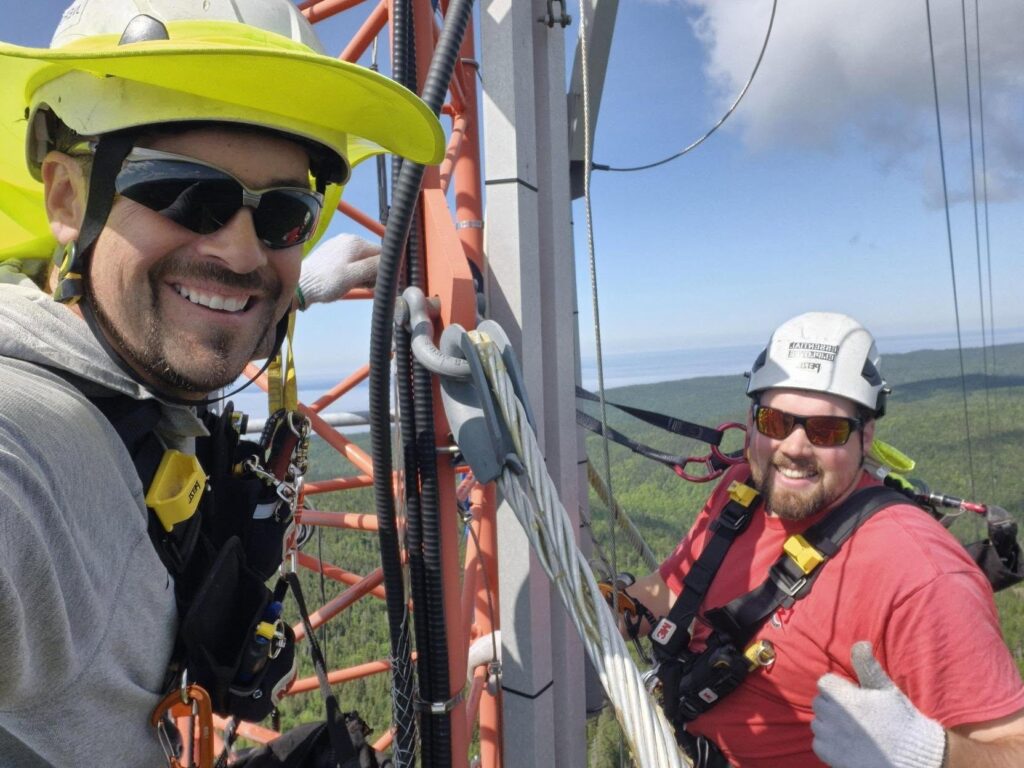
One at a time, we begin the climb. It’s a marathon, not a sprint. Everyone has their own pace, and it’s their duty to respect it. I say “we” because no one works alone here. Relying on the quality of a coworker’s work is one thing; entrusting your safety to them is another—and that creates a bond I’ve never experienced anywhere else.
« When I climb a weather mast, I’m secured, focused, and 100% dedicated to the task at hand and the ones that follow. You have to understand the entire sequence of tasks to avoid any confusion. A single mistake can be fatal. Being in the mast requires constant concentration. But during short breaks or lunch, which we take while still suspended in our harnesses, it’s a chance to look into the distance. Far into the distance. And to think to myself: Wow, I get paid to be here! »
Antoine Amossé, Operations and Maintenance Supervisor

Few people know this, but wind turbines talk. When something goes wrong, they send error messages. The problem is that they communicate like a young child: the signals are rarely clear and point in three different directions at once.
One evening, a blade wouldn’t snap back into place. We climbed up late, lightly equipped, without tools, just to check it out. As we entered the hub, it smelled like something was burning. That’s never a good sign. My colleague came up behind me, sniffed the air, and looked at me with a dramatic expression. Diagnosing a wind turbine is a multisensory experience. We started going through the system step by step. What could be burning? And what’s involved in controlling the blades? One thing led to another, and we came across a backup battery pack—the one that controls the blades in the event of a power outage. In other words, the one we use when the machine needs to shut down quickly.
That evening, we were treated to an unforgettable Gaspé sunset. From where we stood, we could see mountains stretching all the way to the Gulf of St. Lawrence. A view spanning hundreds of kilometers. Few people are lucky enough to see something like that even once in their lives. The next day, in the early hours of the morning, we went back to do the work that needed to be done.

Finding the cause of the breakdown, in this case, was the easy part. The real challenge began after that: finding the part.
That’s what nobody talks about when it comes to maintenance. People tend to think of it as a machine problem, but it’s just as much a logistics and network issue. If the part isn’t in stock, you have to know who to talk to at nearby facilities, know the right people, and call them. A wind turbine that’s shut down doesn’t start up again just because you’ve figured out the problem; it starts up again because someone, somewhere, had the part and answered the phone.
The rest of the time, it’s this combination that defines the job. A wind turbine is a system where mechanical, electrical, and software components interact—sometimes in unexpected ways. The symptom appears in one place, but the cause lies three systems away. You have to be both methodical and creative at the same time. No matter how many manuals, wiring diagrams, etc., but they don’t tell the whole story.
And if the work isn't finished, we head back down anyway. Fatigue and heights don't mix, and no job is worth that risk.

Antoine Duplantie-Grenier
I’ve talked here about the perks of the job. But there’s more to it, too. It gets hot inside those machines, and it gets cold inside those machines. With the harness, climbing gear, and protective gear, you’re carrying dozens of pounds more than your own weight all day long. So, when you get back to the garage after a successful job, taking off your harness lifts a weight off your shoulders—both literally and figuratively.
I chose engineering because of my curiosity and my desire to contribute to something. My first jobs involved sitting in front of a screen, and after ten years in the restaurant industry—where everything hinges on tight coordination and human interaction—the contrast was too great.
My degree in electrical engineering and my master’s in energy engineering gave me the concepts. That’s where they took root. I see the nuances, and above all, I apply them in a context that’s impossible to replicate in theory. Energy exists in a complex world, and that world doesn’t fit into a textbook. The field isn’t just a stepping stone to real engineering. That’s where the data comes from.
For a technician, it's a rare place where you get to work with high-tech equipment every day. For an engineer, it's a chance to get hands-on with machines that you've only ever seen in diagrams.
« When you’re at the top of the gondola, 80 meters up, you can see the entire area. There’s a silence up there that few jobs offer. It’s physically demanding, it’s technical, and every day is different..»
Jean-Philippe Rioux, Operations and Maintenance Technician

Stay up to date on the latest industry news by subscribing to our newsletter today.

Privacy policy ©2026 Nergica | Réalisation DACTYLO