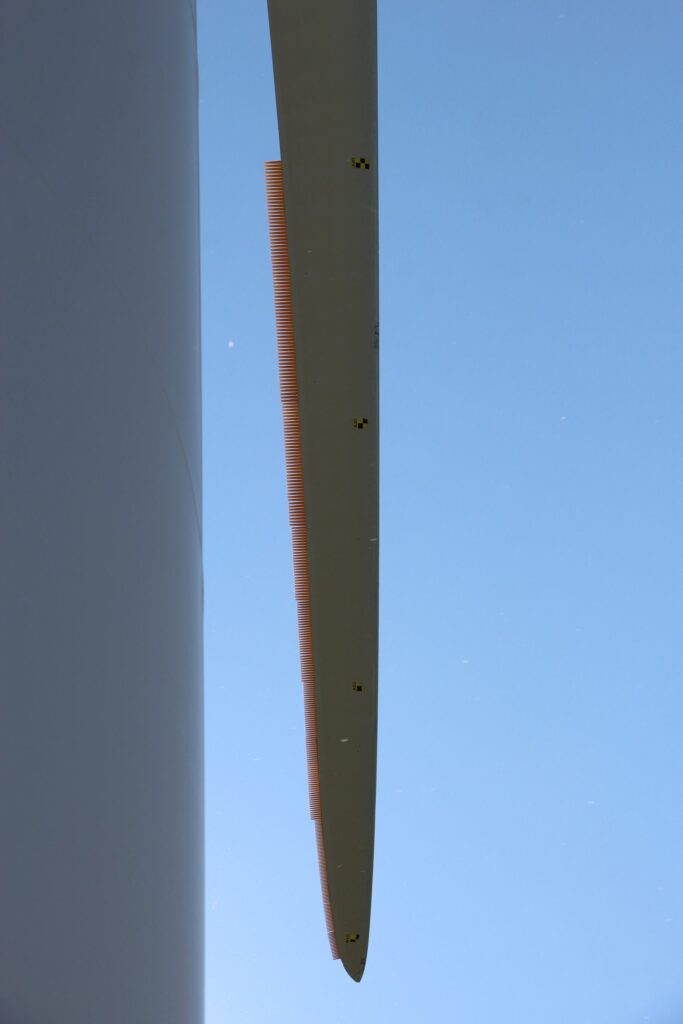
Feasibility study on adapting sensors for wind power in cold climates
Wind power
Wind power
Frost changes everything for a wind turbine. Just a few millimeters of ice buildup on the leading edge of a blade is enough to disrupt airflow, cause a drop in power output, and complicate the operation of wind farms in cold climates. To take timely action, however, the ice must be detected as soon as it forms.
The aerospace industry is well aware of this problem and has developed sensors capable of precisely tracking airflow over a surface. Could these instruments be just as useful for wind turbine blades? That is the question we explored at Nergica, in partnership with Marinvent, during the second half of 2019.
We conducted a technical review of these sensors to verify two hypotheses. First, their ability to detect disturbances in airflow caused by ice. Second, their potential to optimize rotor performance during normal operation, when no icing is occurring.
The study confirmed the proper performance of the sensors installed on the blades and documented the effect of ice accretion on the wind turbine’s aerodynamics. It also revealed an unexpected capability: the detection of leading-edge erosion and debris accumulation.
These results point to a concrete solution. By integrating these sensors with the turbine’s control system, it would be possible to adjust its operation in real time and improve performance. This would make wind power more reliable in areas where winter puts wind farms to the test.
Stay up to date on the latest industry news by subscribing to our newsletter today.

Privacy policy ©2026 Nergica | Réalisation DACTYLO
 View all projects