Development and validation of an icing prediction model for wind farms
Wind power
Wind power
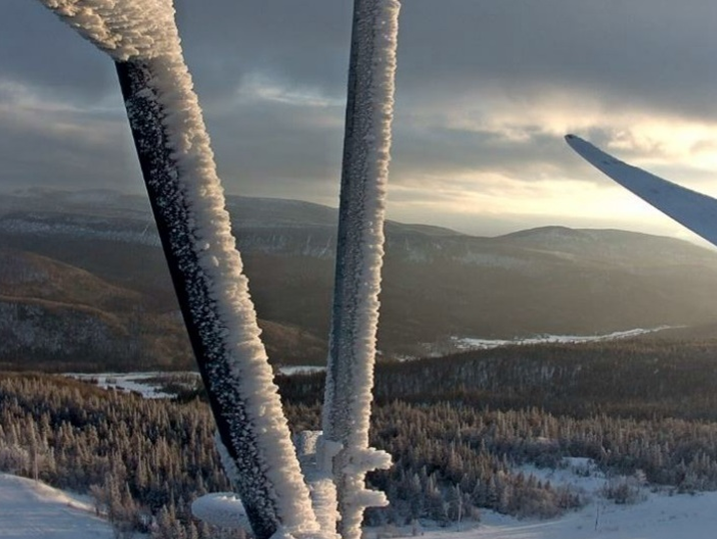
Icing poses a major operational challenge for wind farms, resulting in energy losses that are difficult to anticipate and quantify. Together with Natural Resources Canada, we have developed and validated GPEO, an icing and operational energy loss model, formerly known as GLJM. This model uses operational weather forecasts from Environment and Climate Change Canada to simulate three types of icing events: freezing rain, icing clouds, and sticky snow.
To carry out this validation, we used observational data collected at wind farms over two full winters. This data allowed us to identify and characterize the icing events that occurred in the field. Each of these events was then modeled using GPEO, which allowed us to accurately calculate the corresponding operational losses.
To validate the reliability of GPEO, the same events were modeled a second time, this time using WRF, a model commonly used in the wind power industry. This dual modeling allowed for a direct comparison of the two models’ performance and confirmed the robustness of GPEO as a forecasting tool.
This validation work led to concrete improvements to the model, which is now ready for operational use by the wind power industry.
Stay up to date on the latest industry news by subscribing to our newsletter today.

Privacy policy ©2026 Nergica | Réalisation DACTYLO
 Voir toutes les réalisations